
Home / Millville / Car Key Replacement in Millville
Car keys, Millville
Car Key Replacement in Millville: What Is Involved and What to Gather
A lost or snapped car key does not mean a tow and a long wait. Our mobile crew cuts and programs replacements where the vehicle sits, and this page explains what the process involves and what to have ready.
Why a car key is more than a piece of metal
Older car keys were simple cut pieces of brass. Anyone with a blank and a grinder could copy one. Most vehicles on the road today are different. The key carries a small chip, called a transponder, that talks to the car before the engine is allowed to run. If the chip is missing or does not match, the engine may turn over and then shut down, or refuse to crank at all.
Beyond that, many keys include remote buttons for locking and unlocking, a panic alarm, a trunk release or a push button start fob. Each of those functions has to be paired to the car's computer. Replacing a key therefore has two parts: cutting the metal blade if there is one, and programming the electronics so the vehicle recognizes the new key.
Knowing that helps you ask the right questions. When you call or write to a locksmith, you are not only asking for a copy of a key. You are asking for a key that the car will accept, and that takes the right equipment, the right blank and some information about your vehicle.
It also explains why a key copied at a hardware counter sometimes opens the door but will not start the engine. The blade matches, but the chip was never paired. For a car with a transponder, a copy that only matches the metal is half a key, and we would rather tell you that up front than let you find out in the driveway.
The common ways a key goes missing in Millville
Millville is a quiet foothill community with country properties, long private roads and plenty of time spent outdoors. Keys get lost in the places you would expect: a pocket on a walk to check the property line, a toolbox in the barn, a field behind the house, a bucket by the well. A key that falls out of a jacket in tall grass can be hard to find again.
Other failures are less dramatic. A key breaks off in the ignition after years of use. A fob stops responding because the case cracked and the circuit board inside is loose. A key goes through the wash and comes out with a dead chip. A dog chews a remote. The result is the same: you have a vehicle and no reliable way to start it.
If you still have one working key, you are in a much better position. Making a spare from a working key is generally simpler than starting from nothing, so do not wait until the last one fails. Our page on a spare key now versus later explains why.
Country properties add their own twist. A key set down on a tailgate during chores can slide off on a gravel road, and a vehicle left at the far end of a long driveway is not always within easy reach of help. When you are planning for lost keys, think about where your vehicle actually spends its time and who could reach it.
Picture a household with a new baby
Imagine a family in Millville that has just welcomed a newborn. The days are a blur of feeding, sleeping and car seats. One afternoon the only key to the family vehicle disappears, maybe tucked into a diaper bag, maybe set down on a counter that is now covered in baby gear. Nobody remembers where, and there is an appointment the next morning.
This is an invented scenario, but it shows why the details matter. A family in that position does not want to spend an afternoon in a parking lot or arranging a tow with a baby in tow. A mobile service that comes to the driveway, cuts a key and programs it to the vehicle keeps the family at home, close to the crib and the car seat.
It also shows the value of planning ahead. If the household had made a spare key before the baby arrived, the lost key would have been an annoyance rather than a crisis. We often suggest that busy households treat a spare key as basic equipment, stored somewhere safe and known to the second driver.
A newborn also changes how a family thinks about reliability. A dead battery fob or a worn key that starts the car only on the third try is a nuisance with an empty calendar and a real worry when someone needs to get to an appointment on a schedule. Replacing a worn key before it fails is one of the less glamorous but more useful bits of preparation we see.
What we need to know about your vehicle
To cut and program a key, we need to identify the vehicle correctly. That means the make, model and year, and ideally the vehicle identification number, which is the long code usually visible through the windshield on the driver side near the dashboard and printed on the registration. The code lets us look up the exact key type and blade pattern the car needs.
We also ask what kind of key you have or had: a plain metal key, a key with a plastic head that contains a chip, a flip key that folds out of a fob, or a smart key that stays in a pocket or purse. Photos of an old key can help, as can a note about whether the car has a push button start.
Finally, we will ask for proof that the vehicle is yours. That is for your protection as much as ours, because a locksmith should not hand a working key to someone who cannot show a connection to the car. Typically that means identification and some paperwork tied to the vehicle. The exact details depend on the situation, so we explain them at the time you contact us.
- The make, model and year of the vehicle.
- The vehicle identification number, if you can read it.
- What type of key you had: metal, chip, flip or push button.
- Your identification and paperwork showing the vehicle is yours.
Types of car keys, from simple to smart
A basic mechanical key has no chip and works only on the ignition and door cylinders. These are mostly found on older vehicles. They are the easiest to replace because the job is mainly cutting, and a working key can be copied with a standard machine.
A transponder key looks similar but has a chip in the head. The car reads that chip through a small ring around the ignition. Replacing one requires cutting the blade and then programming the chip so the car accepts it. Some vehicles allow on board programming with the right steps, while others need diagnostic equipment connected to the car.
A smart key, sometimes called a proximity fob, lets the car detect the key nearby so you can unlock the door and press a button to start. These do not always have a cut blade for the ignition, though many include a hidden emergency blade for the door. Replacing them is a programming job first, and the fob has to be paired securely to the vehicle. Our guide to car key types in plain words goes further into the differences.
The category your key belongs to also affects what a spare involves. A plain blade is straightforward. A chip key needs programming. A smart fob needs pairing to the vehicle with the right equipment. If you are not sure which one you have, a photo of the key or the vehicle's start button is usually enough for us to tell.
How a mobile replacement works at your vehicle
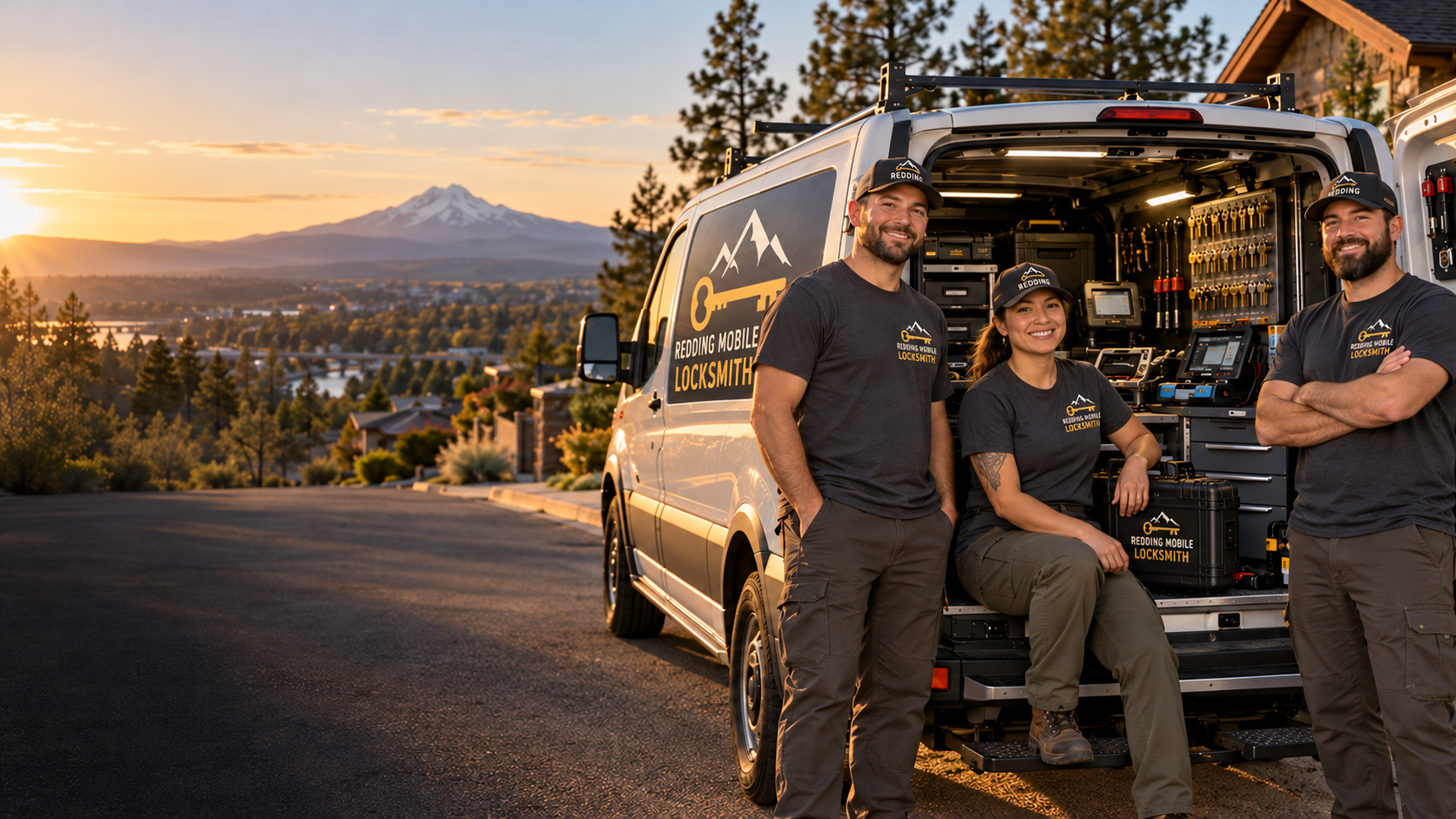
We arrive in a branded service van with the tools and equipment to cut and program keys on site. Once we confirm your vehicle and your connection to it, we select the correct key blank or fob, cut the blade if there is one and prepare the key for programming.
Programming is done with specialized equipment that connects to the vehicle, usually through a port under the dashboard. The equipment tells the car's computer to accept the new key and, in many cases, to forget the lost one. That detail matters: when we can, we remove the lost key from the list of keys the car will accept, so anyone who finds it cannot use it to start your vehicle.
We then test every function. The key has to turn in the door lock and start the engine, the remote has to lock and unlock, and any extra buttons have to work. We would rather spend a few extra minutes testing in your driveway than have you discover a dead remote on the highway. Our wider car key replacement service page covers the process in general terms.
Before we leave, we make sure you understand what each key does. Some vehicles have a main key and a valet key with limited functions, and some fobs have buttons you may never have used. We are happy to show you what each one does, so you do not leave with a key you only half understand.
When every key is gone
Losing all your keys is a harder problem than losing one. There is no working key to copy, so the key has to be created from the vehicle information and programmed through the car's system. It is still a job we can do on site for many vehicles, but it takes more equipment and a bit more time than duplicating an existing key.
In this situation proof of ownership matters even more. We have to be sure the car is yours before we create a key that can start it. Have your identification and vehicle paperwork ready, and be prepared to show them at the vehicle.
If the car is stuck in a spot where you cannot get to it, say so when you contact us, and mention anything unusual about the location such as a locked gate or a long private road. Our field note on what to gather when you have lost every key lays out the checklist in more detail.
Preparation helps here more than anywhere. Find the vehicle registration, a photo identification and, if you can, the title or a loan document. If the vehicle belongs to a business or another person, tell us at the start, because we may need a different kind of proof, and sorting that out early keeps the visit smooth.
Smart keys, fobs and battery trouble
Sometimes a key that seems dead is simply out of battery. A fob that stops unlocking the doors from a distance, or a smart key that makes the dashboard say it cannot detect the key, may only need a fresh coin battery. Replacing a fob battery is a simple job that many drivers do themselves, and it is worth trying before assuming the fob has failed.
If a new battery does not help, the fob may have a cracked circuit board or lost its pairing with the car. We can test the fob, tell you which of those it is, and decide whether reprogramming is enough or a new fob is required.
Water and heat can both damage fobs. Hot dry summers in the foothills can warp plastic cases left on a dashboard, and a fob left in a pocket through a wash cycle can be ruined. Keeping the fob in a cool, dry place is a small habit that extends its life. The field note on key fob battery basics has more.
Other work that goes with a new key
Once a vehicle has a new key, a few related tasks come to mind. A spare is the obvious one, and cutting it at the same time is simpler than arranging a second visit. Some drivers also want a plain metal valet key for the ignition only, and we can talk about whether that suits your vehicle.
If the problem began with a lock rather than a key, we can look at that as well. A stiff door lock or a worn ignition cylinder can damage keys over time. The ignition is where most wear shows up, because the key is turned there more than anywhere else, and a worn cylinder can make a new key feel loose or stuck.
For work on your home keys while we are in Millville, the rekeying in Millville page explains how a property can be moved onto a new set of keys, and the key programming page describes the electronic side of the work in more detail.
A worn ignition is worth a mention on its own. If your key has to be jiggled to turn, or if the car sometimes will not release the key, the cylinder may be wearing out. A new key in a worn ignition can feel no better than the old one, and we would sooner point this out than hand you a key that struggles from day one. The field note on ignition trouble signs lists what to watch for.
Neighbors, nearby communities and how to ask
We serve Millville and the surrounding Shasta County communities, including Cottonwood and Anderson, and a vehicle that is stranded in any of them can get the same mobile service. If your car is parked somewhere other than your home, such as a job site or a roadside pull out, tell us where it is.
Our phone line is coming soon. For now, please use the request form on our contact page and include your vehicle details, the type of key and any notes about the location. We are a 24 hour mobile locksmith, and the form is read around the clock.
If you are locked out of the vehicle rather than missing a key, the car lockout page for Lakehead describes how we approach lockouts across Shasta County, and the automotive locksmith page gives the wider picture of what we do with vehicles.
Common questions
Can you make a car key if I have lost all of them?
In many cases yes. We create a key using your vehicle information and program it to the car on site. It takes more equipment than copying an existing key, and we will ask you to show identification and paperwork connecting you to the vehicle before we begin.
Will my lost key still start my car afterward?
When the vehicle allows it, we remove the lost key from the list of keys the car accepts during programming. That means anyone who finds the old key cannot use it to start the engine. Some vehicles handle this differently, and we explain what applies to yours.
What information should I have ready for a replacement key?
Have the make, model and year of the vehicle, the vehicle identification number if you can read it, a description of your key type, and identification plus paperwork showing the vehicle is yours. Photos of the old key or fob help when you have them.
Does a push button start fob work the same way as a regular key?
No. A push button start vehicle uses a smart fob that the car detects nearby. Replacing it is mostly a programming job, and the new fob has to be paired securely to the vehicle. Many also contain a hidden emergency blade for the door lock.
Should I try a new battery before replacing my fob?
Yes, it is worth trying. A weak coin battery is a common cause of a fob that stops responding. If a fresh battery does not help, the fob may be damaged or have lost its pairing, and we can test it and tell you which.
How do I request car key replacement in Millville?
Our phone line is coming soon. Use the request form on our contact page and give your vehicle details, key type and location. We are a 24 hour mobile locksmith and will follow up using the information you provide.