
Home / Service areas
Where we work
Seventeen communities across two North State counties
Alpine Dispatch travels to eight communities in Shasta County and nine in Siskiyou County. This page lists every one with its ZIP codes, groups them by corridor and links to each town's own page.
The whole territory at a glance
Why list every community by name instead of saying we serve the region? Because a locksmith visit is physical. A technician has to drive to a specific place, and a vague promise of coverage helps nobody standing beside a locked door. Naming each town, with its ZIP codes, is our way of making the commitment concrete and giving you something you can check against your own address.
Our territory starts in the Sacramento Valley at Redding and Anderson and climbs north through the Sacramento River canyon to Mount Shasta, Weed and Yreka, then reaches into Scott Valley, ranch country and forest towns. It crosses two counties and several very different landscapes, and each of them shapes what a locksmith visit looks like.
Seventeen communities make up the list. In Shasta County: Redding, Anderson, Shasta Lake, Cottonwood, Palo Cedro, Millville, Lakehead and Sims. In Siskiyou County: Mount Shasta, Yreka, Dunsmuir, McCloud, Weed, Granada, Montague, Fort Jones and Etna.
Every one of those pages follows the same promise: it describes locksmith needs in that particular place, not a generic template. A town with vacation rentals and a town with ranch gates need different advice, and the pages are written accordingly.
Shasta County: the valley and the lake
Valley towns share one traffic reality: Interstate 5 ties them together. People live in Anderson or Shasta Lake and work in Redding, or the other way around, and that daily movement means keys, cars and doors are constantly changing hands between home and work. A lockout can strike in the driveway at dawn or in a parking space at the end of a long shift.
Redding is the largest city in the region and the Shasta County seat, set on the Sacramento River where Interstate 5, Highway 299 and Highway 44 meet. Its ZIP codes are 96001, 96002 and 96003. Neighborhoods range from older homes to newer subdivisions, with shopping, offices and light industry mixed in, so the Redding page covers a wide range of work.
South of Redding along Interstate 5 sits Anderson (96007), a small city of older and newer homes, rural parcels and small businesses on the valley floor. Further south, Cottonwood (96022) is rural, with acreage, ranch properties, shop buildings, long driveways and gates.
Near Shasta Dam and Lake Shasta, Shasta Lake (96019, 96079 and 96089) mixes family homes, rental housing, lake visitors and people who commute to Redding. Each of these places has its own rhythm, and the pages reflect it.
Shasta County: foothills and the lake arm
Seasonal visitors add another layer in the lake communities. A vacation home may be opened for a weekend and closed for weeks, with guests who have never seen the lock before. That is a recipe for stuck deadbolts, misplaced keys and doors left unsecured. Our guides on securing a vacation rental and lake house and boat storage lock choices speak to exactly that.
East of Redding the landscape turns to oak and pine. Palo Cedro (96073) lies along Highway 44 with homes on larger lots, outbuildings and shops. Millville (96062) sits in the foothills with country properties, wells, barns and long private roads.
At the northern end of Lake Shasta, Lakehead (96051 and 96070) is a mountain lake community near Interstate 5 with vacation homes, marinas and cabins, seasonal visitors and full time residents. North of Lakehead in the Sacramento River canyon, Sims (96017) has scattered homes and cabins in forest.
These communities share a trait: the buildings are often spread out, sometimes up private roads, and some sit empty for stretches. That affects how a locksmith plans a visit and what advice makes sense for locks on cabins and outbuildings.
Siskiyou County: the Interstate 5 corridor
The corridor towns also have the most mixed housing and commerce. Older downtown buildings in Yreka and small downtown businesses in Mount Shasta often carry original doors with newer locks fitted into them, which creates alignment and hardware questions you rarely meet in a subdivision. A site visit usually tells the story at a glance, but a good description beforehand saves a lot of guessing.
Heading north, Dunsmuir (96025) is a small town in the upper Sacramento River canyon along Interstate 5 and the railroad, with older homes on steep lots, forest and cold winters. Mount Shasta (96067) is a mountain city at the foot of the mountain it is named for, with snowy winters, vacation rentals and cabins, outdoor visitors and small downtown businesses.
Weed (96094) sits north of Mount Shasta where Interstate 5 meets Highway 97. It has a college, local businesses, highway travelers and windy open terrain. Yreka (96097), the Siskiyou County seat, lies along Interstate 5 in the Shasta Valley area with older downtown buildings, county and professional offices, neighborhoods and rural edges.
These four towns see a lot of people passing through, which means a lot of vehicle keys, rental properties and locked doors on a trip.
Siskiyou County: forest, valley and ranch country
Cold is the common thread out here. Frozen cylinders, stiff weatherstripping and snow drifted against a doorway are all part of winter life in McCloud, Fort Jones and Etna. Our guides on locks and door seals in mountain homes and a deadbolt that sticks only in the cold explain why the problems appear in winter and what you can do about them.
East of Mount Shasta on Highway 89, McCloud (96057) is a forest town with older wood frame homes, cabins, snowy winters and a quiet small town feel. In the Shasta Valley, Montague (96064) has older homes, agricultural surroundings and small main street businesses, and Granada (96038) is a small community near Montague with rural homes, open ranch country, outbuildings and gates.
Farther into the county, Scott Valley holds Fort Jones (96032), with ranch and farm properties, older homes, small businesses and cold winters, and Etna (96027), with older downtown buildings, ranch properties, mountain views and cold winters.
In places like these, a locksmith visit may involve a gate, a barn latch, a farm truck or a century old front door. The pages for these towns lean into that variety.
How the corridors connect
Seasonal change reshapes the map as well. A route that is simple in July can be slow or closed in a winter storm, and a gravel road to a cabin may be soft after rain. The crew treats current conditions as part of every trip and will tell you if conditions make a visit more involved than usual.
This shape also explains why we ask about where you are headed as well as where you are. A traveler on Interstate 5 who loses a key in Weed may be bound for Redding or for Oregon, and the right way to replace a vehicle key can depend on whether the car has to keep moving. Tell the crew your situation honestly and they will plan around it.
Think of the territory as a few lines on a map. Interstate 5 runs through the middle from the Redding area through Anderson and Shasta Lake, along Lake Shasta to Lakehead and Sims, up the canyon to Dunsmuir, past Mount Shasta and Weed, and across the Shasta Valley to Yreka. Highway 299 and Highway 44 reach out from Redding. Highway 89 reaches McCloud. Highway 97 leaves Interstate 5 at Weed.
We describe the geography in broad strokes on purpose. We do not publish distances or travel times, because a figure that is true on a dry afternoon can be wrong in a snowstorm. Instead, the crew confirms the trip with you when you reach out, using your exact location and current conditions.
For you, that means the most useful thing to include on the request form is a clear location: the town, the road or the landmark, and whether the spot is safe to wait in. The request form has room for all of it.
ZIP codes served
Mailing addresses in rural areas can be misleading. A property near Cottonwood or Millville might carry a ZIP code for a town some distance away, or a post office box that does not describe the physical location. For a mobile crew, the physical location is everything, so include a road name, a gate or a description of how to find you whenever the address alone could be unclear.
Here is the full list, so you can match your address with ease:
ZIP codes do not always follow town limits. If your address is near a boundary or on a rural route, name the nearest town and describe where you are. The crew would rather ask one extra question than head to the wrong place.
- Redding: 96001, 96002 and 96003.
- Anderson: 96007, Cottonwood: 96022, and Palo Cedro: 96073.
- Shasta Lake: 96019, 96079 and 96089, with Millville at 96062.
- Lakehead: 96051 and 96070, with Sims at 96017.
- Mount Shasta: 96067, Dunsmuir: 96025, McCloud: 96057, and Weed: 96094.
- Yreka: 96097, Granada: 96038, Montague: 96064, Fort Jones: 96032 and Etna: 96027.
What changes from town to town
There is one more difference worth naming: how busy a place is after dark. A downtown business street, a quiet forest road and an open highway pull off all feel different at night, and safety shapes the advice we give. Waiting by the car in a well lit spot is a good idea anywhere, and our guides on waiting safely are written with that in mind.
A few patterns repeat. In the valley towns, summer heat is the main hazard to locks and key fobs, and homes range from older to newer. In the mountain towns, snow and cold shape everything from frozen deadbolts to door seals. In ranch and farm communities, the key themes are gates, padlocks and outbuildings. In the lake and forest communities, the themes are vacation rentals, cabins and second homes.
Each theme has a guide behind it. Read a lock strategy for cabins and second homes if you own a property that sits empty. Read gates and padlocks on rural property if you have acreage. Read winter lockouts and frozen locks in the mountains if snow is part of your year.
Whichever pattern fits your place, the twelve services are the same. The services overview explains each one, and every town page links to six specific local pages that apply a service to that town.
The six local pages in every town
These pages are intentionally not interchangeable. The car lockout page for a lake community discusses boat trailer hitches and marina lots in general terms, while the same page for a mountain city discusses cold nights and snow. If you see a familiar sentence between two town pages, tell us, because the goal is that every page reads as if it could only belong to its place.
Under each community page you will find six narrower pages: car lockout, house lockout, rekeying, car key replacement, commercial locksmith and lock repair. Each one is written through the lens of its town, so the rekeying page for a lake community reads differently from the rekeying page for a ranch town.
They are useful if you already know what you need. Someone stuck outside a vehicle can go straight to the car lockout page for their town. A landlord can go straight to rekeying. A shop owner can go to commercial locksmith. Each page includes questions and answers specific to that combination.
If you are not sure what you need, start on the town page, which covers the whole range of locksmith needs there and links to all six local pages. From there you can drill down.
Asking for help from your community
Before you write to us, take a moment to look at your own town's page. It lists the ZIP codes that belong to it, describes the kinds of buildings and weather you live with, and links to the six local pages. Reading it first often answers a question before you ask it, and it tells you what the crew already understands about your surroundings.
If your town sits near the edge of the territory, such as Sims in the canyon or Etna in Scott Valley, include any road conditions you know about. Snow on a mountain road or a washed out gravel track changes how a technician plans, and your local knowledge is worth more than any map.
One last practical note. If you are helping someone else, such as a parent in Etna or a friend stranded outside Yreka, you can fill out the request form on their behalf. Give their exact location and explain who they are, and be ready for the technician to confirm that the person on site is entitled to open the lock. That confirmation protects them, and it protects you.
When you are ready to reach the crew, use the request form on the contact page. Say which community you are in, describe what happened and tell us whether you are at a home, a business or a vehicle. Our phone line is coming soon, so the form is how to reach us for now.
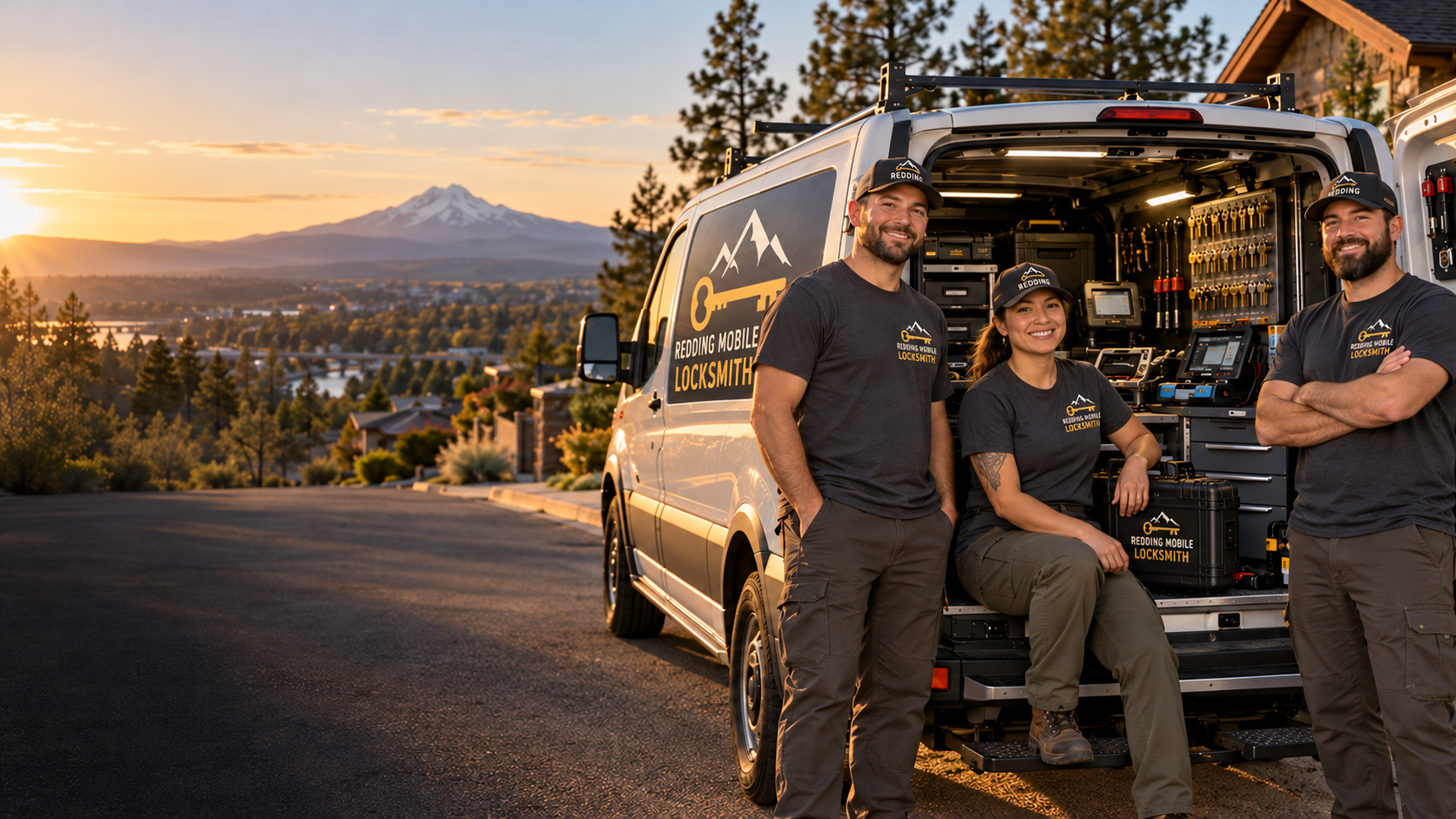
If you want to know who you would be dealing with before you ask, the about page describes the crew, the uniforms and the branded vans. And if you would like to read first, the field notes library has 70 guides that apply anywhere in our territory.
Whatever your town, we hope this page helps you feel less alone when a lock fails. The North State is a big place, and the point of a mobile crew is to meet you where you are.
Common questions
Which communities does Alpine Dispatch serve?
We serve 17 communities. In Shasta County: Redding, Anderson, Shasta Lake, Cottonwood, Palo Cedro, Millville, Lakehead and Sims. In Siskiyou County: Mount Shasta, Yreka, Dunsmuir, McCloud, Weed, Granada, Montague, Fort Jones and Etna. Each has its own page with ZIP codes and local notes.
What if my address is between two towns?
Name the nearest town on the request form and describe where you are, including the road or a clear landmark. ZIP codes do not always follow town lines, and a precise description of your location helps the crew plan the trip.
Do you publish travel times for each town?
No. Conditions on mountain passes, rural roads and Interstate 5 change with weather and traffic, so a fixed figure would mislead. The crew confirms the trip with you when you make contact, using your exact location.
Why do the town pages differ from one another?
Because the places differ. A lake community with vacation rentals needs different advice than a ranch town with gates or a mountain town with snow. Each page is written around what locksmith needs look like in that specific community.
Is every service available in every community?
Our twelve services apply across the territory, and the crew travels with the equipment to handle most jobs on location. If a particular job is not possible in a given spot, the crew will tell you plainly when you reach out.
What should I include when I request help?
Include your community, a clear description of your location, what has happened and whether the problem involves a home, a business or a vehicle. Mention the vehicle make or the type of door if you can. These details help the crew prepare.