
Home / Service areas / Anderson
Anderson, Shasta County
Mobile Locksmith Help in Anderson, California
Anderson sits on the valley floor along Interstate 5, with old streets, new subdivisions, open parcels and small shops all within the same few miles of road. Here is how our crew handles locks and keys across that mix.
Anderson from the driver's seat
Come into Anderson on Interstate 5 and the town reads in a glance: a grid of older streets, newer neighborhoods stitched on at the edges, open parcels beyond, and small businesses scattered along the roads that carry traffic through. Zip code 96007 covers all of it, and every kind of lock problem shows up somewhere in that mix. We keep the van stocked for that variety rather than for one type of job.
A mobile locksmith is useful here because the work rarely happens in a shop. The stuck door is at a house. The dead car is in a driveway, a feed store lot or on a shoulder near the freeway. The broken key is in a gate padlock on a parcel with no street number you could read from the road. So the whole idea of our crew is that the bench comes to you: key cutting, programming equipment and common hardware ride in the vehicle.
This page is a map of the locksmith needs we see in and around Anderson, written so you can find your situation, recognize what is probably going on and know what to do next. At the bottom you will find the six local pages for the town, each focused on one kind of job, plus links to the neighboring communities we also serve.
Older homes and the locks they grew up with
Many of the older houses in Anderson still carry hardware from several remodels ago. A front door might have a knob lock from one decade, a deadbolt added in another, and a back door that nobody has touched. Brass wears, springs tire, and keys that were copied from copies slowly drift away from the original cut. The result is a door that works on a good day and traps you on a bad one.
Wear shows up in predictable ways. The key goes in but has to be wiggled. The deadbolt throws only when you lift the door slightly. The latch bolt no longer reaches the strike plate because the house has settled and the door has sagged a little on its hinges. None of these are emergencies on day one, but each is a lockout waiting for a bad moment, like arriving home with groceries in the dark.
When we look at an older door we check the whole system, not only the cylinder. That means the key, the cylinder, the latch, the strike plate and the way the door meets the frame. Sometimes a lock repair in Anderson is all it takes. Sometimes the honest answer is that a worn lock has reached the end, and a fresh installation is better than another repair.
Newer homes and the first week after a move
The newer neighborhoods tend to have the opposite problem. The hardware is recent, but nobody knows how many keys exist. Builders, agents, inspectors, previous owners and their relatives may all have held a copy at some point. Most people never think about this until a friend asks if the old owner ever got the keys back. The honest answer is usually that nobody knows, and the simplest way to settle the question is to change what the lock accepts.
That is where rekeying in Anderson earns its place. Rekeying changes the internal pin arrangement of an existing lock so that old keys stop working and a new key takes over, without replacing the hardware you already like. All the doors can be set to one key, which also means one fewer ring of keys to carry and lose.
A new home also tends to hide small lock gaps: a side door that was never fitted with the same deadbolt as the front, a garage entry door that sticks, a sliding door with a latch that barely catches. Walk the house with a short list before you settle in, checking each exterior door, the garage entry, any sliding doors and every window that opens at ground level. Our guide on a lock checklist for your first day in a new home gives you the order we would follow.
Rural parcels, gates and outbuildings
Step off the main roads around Anderson and the properties get bigger. A gate at the end of a driveway, a shop behind the house, a storage shed, a pump house, a livestock shelter. Every one of those has a lock of some kind, and they live outdoors, where dust, sun and rain wear on them harder than anything indoors.
Padlocks and gate latches are the most common complaint. A shackle that rusts shut, a key that snaps off in a stiff cylinder, a chain that was cut once and replaced with something weaker. The fix may be a new padlock, a better hasp or a rekey of a keyed alike set so the same key opens the gate, the shop and the shed. Padlocks built for weather with covered keyways resist dust and moisture far better than a basic hardware store model, and a hardened shackle takes much more effort to cut. A shielded shackle, where the body wraps around the steel, is harder to attack with bolt cutters still.
If you manage several buildings on a parcel, think about a simple key plan. Decide which doors share a key and which should not, write it down and keep one spare at a safe place. Our notes on gates and padlocks on rural property and barn, shop and outbuilding locks go into the details.
Cars, trucks and the Interstate 5 corridor
Anderson is a place people pass through and a place people commute from, so a lot of car trouble happens within sight of the freeway. Someone steps out to check a tire and the door shuts with the key inside. A fob battery dies in a parking lot. A spare key goes missing the same week the only remaining one cracks along the blade.
For a locked car, a professional uses tools made for the job and does not damage the door, the weatherstrip or the window. See our page on car lockout service and the town specific car lockout page for Anderson. If a child or an animal is locked inside a vehicle, call emergency services first, before anyone calls us.
When the problem is the key itself, the answer depends on the vehicle. Many keys carry a transponder chip that talks to the car, and a lost key may need a new one cut and programmed on site. Read car key types in plain words to see what you are likely holding, then look at car key replacement in Anderson for the practical steps.
Small businesses along the main roads
Anderson businesses range from a one person shop to a storefront with a handful of staff. The lock questions are similar: who has keys, what happens when someone leaves, does the back door latch properly, and how do you get in at six in the morning when the key will not turn. A business that loses access loses a day of income, so small hardware problems deserve attention early.
Common jobs include a storefront cylinder that has worn, a back door with a failed closer, an office door that needs to be rekeyed after a staff change, and a push bar that has started to stick. For anything involving exit doors, we explain what hardware does and let the property owner confirm what their local rules require, because requirements differ by building type and jurisdiction.
Our commercial locksmith page for Anderson covers these jobs in more depth, and the broader commercial locksmith service page explains how we approach larger sets of doors. For a long term view, key control at opening and closing is a good place to begin.
What the summer heat does to locks
Summers in the valley are hot and dry, and the heat reaches the hardware. Metal expands, plastic parts soften, and door frames shift slightly. A deadbolt that slides smoothly in April may bind in August because the bolt and the strike no longer line up exactly. Car door lock actuators run harder in a cabin that has baked in the sun.
Dust is the other summer problem, and in a dry valley it is everywhere. Fine grit works its way into keyways and latch mechanisms, and when it mixes with the wrong lubricant it forms a paste. We tend to steer people away from heavy oils and toward dry graphite or products made for locks, and we explain why in lock lubricants: what helps and what hurts.
If a lock sticks every hot afternoon, treat that as a signal and not a quirk. Check whether the door rubs the frame, whether the strike plate has shifted and whether the key itself is worn. Our piece on why locks stick in hot summer weather walks through those checks in order.
Cooler months, wet mornings and early starts
Valley winters around Anderson are mild compared to the mountains, but cool damp mornings still affect locks. Moisture gets into cylinders, doors swell slightly, and a lock that was stiff all summer may refuse to turn after a wet week. Combine that with early commutes and short daylight, and lockouts tend to happen in the dark with cold hands. Fumbling with a key you cannot see is how keys bend, and a bent key is how a simple morning becomes a service call.
A few habits help. Carry a spare key somewhere that is not the same pocket as the main one. Give a trusted person at a safe location a copy, not under the mat. Keep a charged phone, and know how you will describe the problem when you ask for help.
Those habits matter more as you head north toward the mountains, where cold and snow bring harder lock problems. If you drive that way, take a moment to read preventing snow day lockouts before your trip.
The six Anderson pages and what each covers
We split our Anderson coverage into six pages so you can go straight to what you need. Car lockout in Anderson and house lockout in Anderson deal with getting you back inside a locked vehicle or home. Rekeying in Anderson covers changing who holds access without changing hardware.
Car key replacement in Anderson is for lost keys, broken fobs and spare keys that need to be made. Commercial locksmith work in Anderson covers shops, offices and doors with heavier use. Lock repair in Anderson deals with sticking, loose, misaligned and worn hardware.
Each page is written around its own questions, so you will not find the same text repeated. If your situation crosses two pages, read both. A house with a worn cylinder and a lost key, for example, may need repair and rekeying in the same visit.
How to get help in Anderson
The phone line is coming soon. For now, use the request form on our contact page. Tell us the town, the type of lock or vehicle, what has already happened and whether anyone is at risk. If it is an emergency where someone is hurt, in danger or locked in a hot car, call emergency services first.
When you describe the problem, short and concrete works well. Say the key turns halfway, or the fob light is dead, or the deadbolt will not throw. Mention whether the door is open or shut, whether you can still reach anything inside and what time pressure you are under.
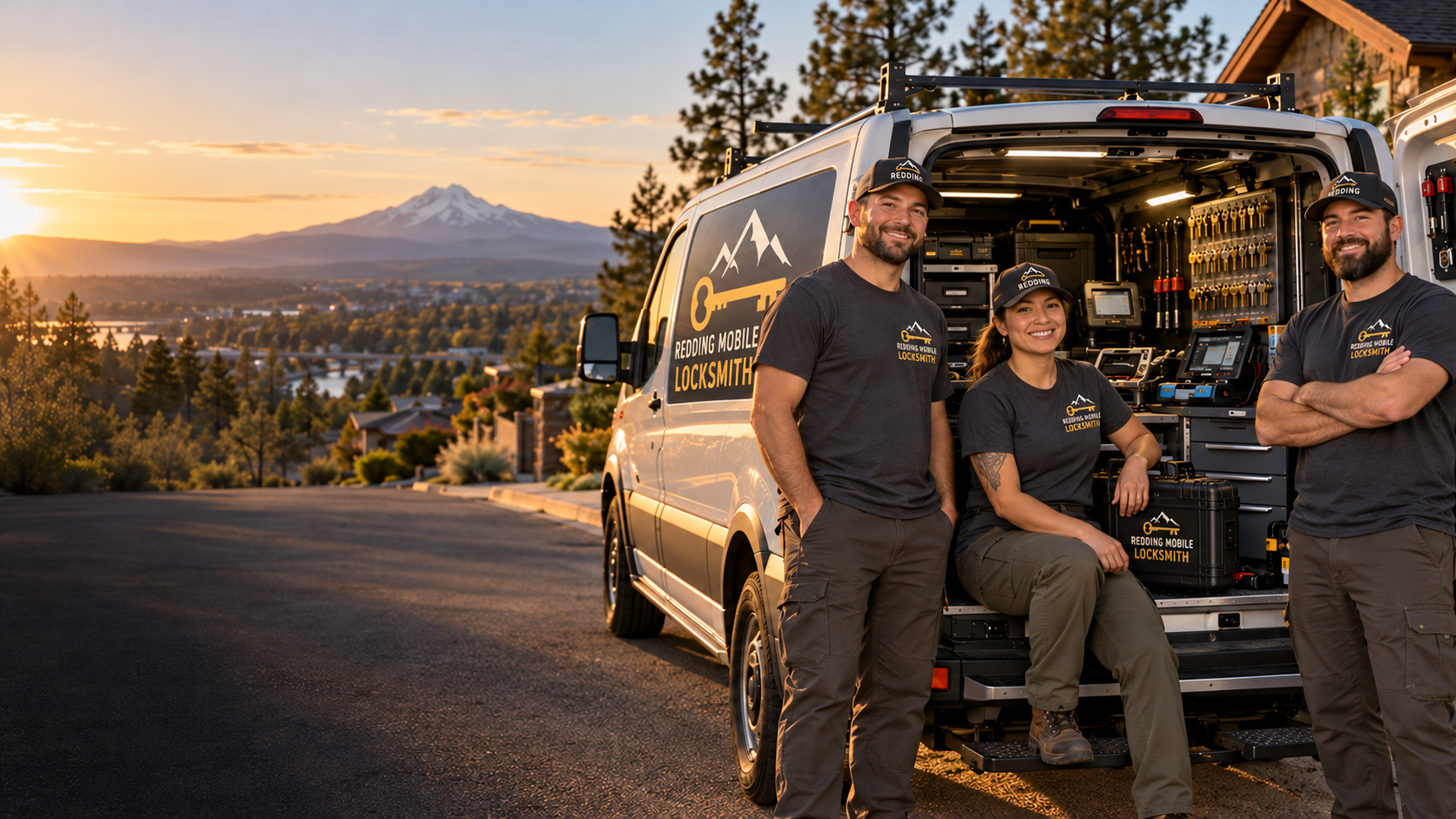
Our crew arrives in uniform in a branded service van, so you will know who is at the door. Before work starts, we explain what we plan to do and what it involves, so nothing surprises you afterward. If the plan changes once we see the lock up close, we say so and talk it through before anything else happens. For wider coverage, see all communities we serve.
Nearby communities we also cover
Anderson is one stop on a corridor that runs through Shasta County. To the north is Redding, the largest city in the region and the one most travelers pass through. South of Anderson is Cottonwood, with its acreage and gated properties. Closer to the lake is Shasta Lake.
If you live on the edge of two communities or work in one and sleep in another, you can use whichever page matches the problem. The service itself is the same, and the crew carries the same equipment wherever the call comes from. A lockout in a quiet Anderson neighborhood and a lockout on a county road near Cottonwood call for the same careful approach: confirm who you are, confirm the lock, choose the least damaging way in and leave the door working properly. That steady routine is the part of the job people remember, long after the stress of the moment has faded.
For general information about our work, browse the full services list, or read through the field notes for plain language explanations of how locks and keys behave.
Common questions
Do you serve all of Anderson, including the rural parcels?
Yes. We cover the town and the surrounding area in zip code 96007, including homes on larger lots, gated properties and outbuildings. When you contact us, describe how to find the gate or driveway and mention anything unusual, such as a locked entrance, so the crew can plan the visit properly.
What should I have ready when I ask for a locksmith in Anderson?
Have the location, the kind of lock or vehicle, what happened and whether anyone is in danger. For a car, the make, model and year help. For a home or business, say whether you own the property or rent. Be ready to show that you belong there before we open anything.
Can you make a new car key at my house or on the roadside?
In many cases, yes. The van carries key cutting and programming equipment, so a new key can often be cut and set up where the vehicle sits. Some vehicles are more complex than others, so describe the vehicle clearly and we will tell you what the job involves before we begin.
Is rekeying better than replacing the locks?
It depends on the condition of the hardware. If the locks work smoothly and look sound, rekeying is a sensible way to cancel old keys without buying new hardware. If the lock is worn, damaged or poorly matched to the door, replacement is usually the better choice. We will explain which applies.
What if a child or a pet is locked inside a car?
Call emergency services first. A child or animal in a closed vehicle can be in danger within moments, especially in summer heat. Responders are trained and equipped for this. After they are on the way, you can contact us about the vehicle, but do not wait on us when a life is at risk.
How do I reach you if the phone line is not live yet?
The call line is coming soon. Until then, send a request through the form on our contact page. Include your town, the lock or vehicle involved and a short description of the problem. If someone is hurt or in danger, contact emergency services directly instead of using a form.