
What a house lockout really is
A house lockout means you cannot get through a door you have every right to use. The key might be inside, lost on a trail, snapped off in the cylinder, or sitting in a coat pocket in another town. The lock itself may be perfectly healthy. In most cases the problem is access, not hardware, and that matters because it changes how we approach the job.
Our team at Redding Mobile Locksmith treats a lockout as a puzzle with a gentle answer first. The goal is to get you inside with the door, frame and lock still working, so that when you walk in you do not also have a repair bill and a draft. Forced entry is the last tool on the bench, not the first.
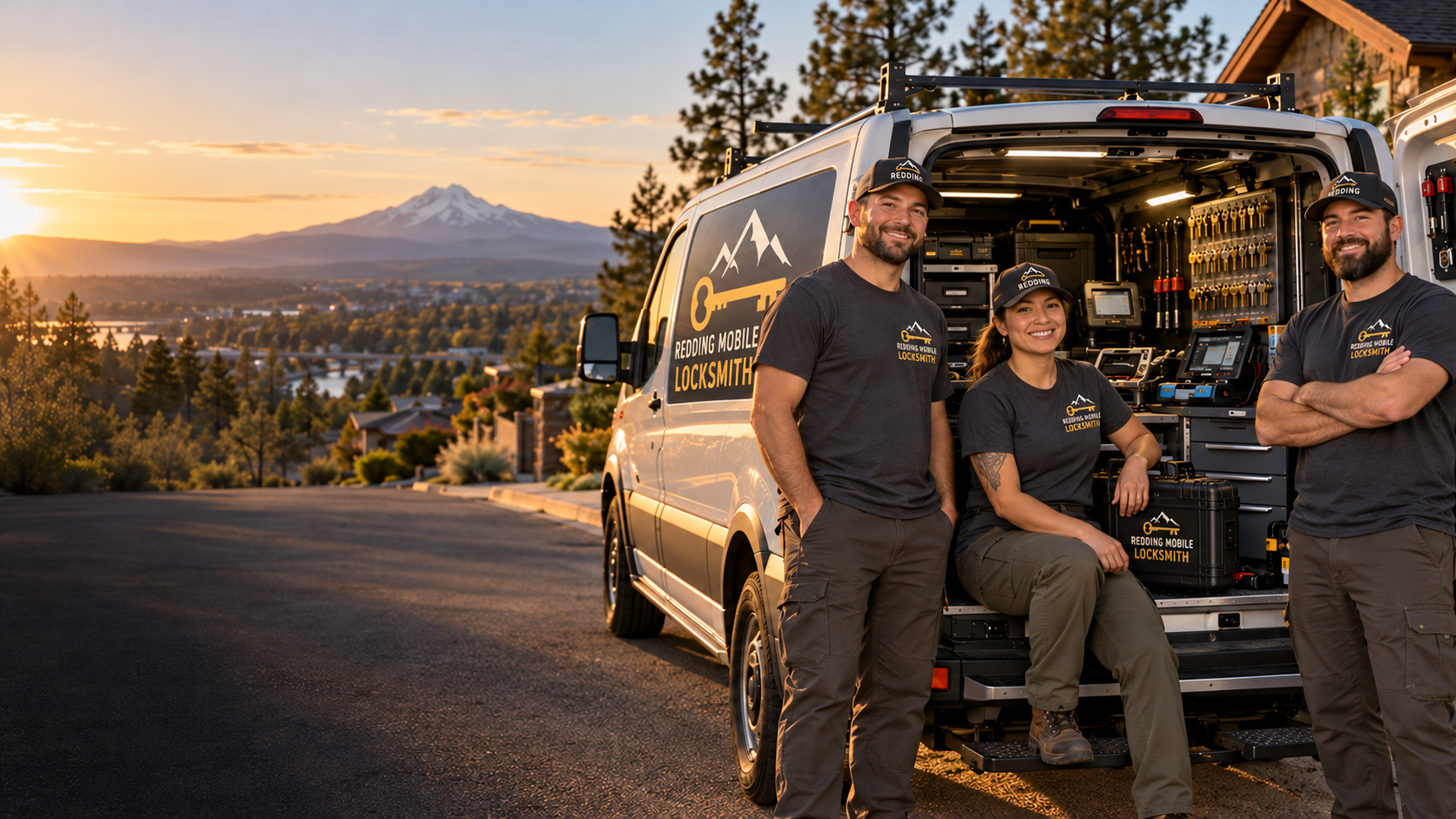
We work from a branded service van that carries professional tools and common hardware, and we cover homes across Shasta County and Siskiyou County. That includes valley neighborhoods around Redding and Anderson, and snow country homes up the Interstate 5 corridor. The same calm order of options applies whether the house is a ranch rambler or a mountain cabin.
The sensible order of options
Think of a lockout as a ladder. You start on the lowest rung, the one that costs nothing and risks nothing, and only climb when that rung does not hold. Most people jump straight to the top rung because panic makes everything feel urgent, and that is where doors get damaged.
The first rung is simply checking what you already have. Another entrance, a spare held by someone you trust, a window latch you left open on purpose, a smart lock app on your phone. The second rung is a professional non destructive entry, which is what we do. The third rung is partial disassembly of the lock. The last rung, and a rare one, is drilling or removing hardware, and we only suggest it when the lock has failed or cannot be opened any other way.
Ordering matters because each rung down tends to leave a mark. A door that is entered gently can be locked again the moment you walk through it. A door that is forced may need a new strike, a new cylinder, even new trim, and in a cold month it may not close properly until the work is done.
- Check every other door, the garage entry and any window you control before anything else.
- Call someone who holds a spare, and ask them to check before you wait around.
- Look for a smart lock, keypad code or app that may let you in without a key.
- Ask a locksmith to open the lock without drilling or breaking anything.
- Accept hardware removal only when the lock is damaged or the gentle options have run out.
Before you call: a calm three minute check
Take a slow lap before you dial. Walk the outside of the house, trying each door by the handle, not by force. Look at windows you can reach from the ground only, and do not climb onto roofs, ladders or porch rails in the dark or on ice. A fall is a much bigger problem than a lockout.
Next, think about the lock you actually have. A single cylinder deadbolt that locks with a key outside and a thumb turn inside behaves differently from a double cylinder that needs a key on both sides. A latch that was only pushed shut is different from a bolt that was thrown. Knowing which of these you have lets us bring the right approach to the door.
Finally, gather what proves the house is yours. A utility bill, a mail piece or an ID with the address on it is the sort of thing a responsible locksmith will ask to see. It is not suspicion. It is the same care you would want from someone opening your front door if a stranger asked them to.
What we do at the door
When we arrive in our uniforms and branded van, we start by looking at the door rather than the lock. We want to know how it hangs, which way it opens, whether the strike plate lines up, and what kind of bolt is holding it. A door that has sagged a little tends to bind the latch, and a bound latch can be opened very differently from a clean one.
From there we choose the least invasive method that fits the hardware. We describe it to you in plain words as we go, because you are standing there wondering what is happening to your home. We do not explain techniques that would help someone with bad intentions, and we will not open a door for someone who cannot show they belong there.
Once the door is open, we check that the lock still turns freely, that the bolt throws fully into the frame, and that the key you have, if any, still works. If something is worn or damaged, we tell you before we leave, and you decide what happens next.
Why doors get damaged and how to avoid it
Most lockout damage is self inflicted by helpful people in a hurry. A credit card forced past a latch can snap the card and chew the weatherstrip. A screwdriver wedged between door and jamb can split the wood. A shoulder against a deadbolted door can crack the frame at the strike, and a cracked frame means the door will never feel as solid again.
Pried locks are the worst version. A deadbolt that is levered off its seat may leave the bolt jammed, the cylinder twisted and the edge of the door chewed. In older houses with softer wood this happens easily. In newer houses with steel doors it can bend the skin and leave a ridge that no paint will hide.
If you have already tried something, tell us. It changes what we see and how we proceed, and it saves everyone from guessing. A bent latch from an earlier attempt can look like a lock failure when it is really a small bend that can be straightened.
- Do not wedge tools between the door and the frame.
- Do not kick or shoulder a deadbolted door.
- Do not pour oil or spray into a stiff lock before we arrive.
- Do not climb to an upper window without a safe, sturdy ladder and a helper.
- Do tell us exactly what you tried and in what order.
Lockouts with a child, a pet or a stove on
Some lockouts are not just inconvenient. If a young child is alone inside, if someone in the house needs help, if you can smell gas, or if something is burning, call emergency services first. They have tools and training for those moments and are the right people to decide how to get through the door. A locksmith is not a substitute for a fire crew or a medical team.
If a pet is shut inside on a hot day, the same logic applies: contact local authorities or animal control when there is any sign of distress, and do not wait for a locksmith to decide it is an emergency. Summer heat in the valley can build in a closed house surprisingly soon, and in the mountains a freezing night can do the opposite.
For everything that is not an emergency but is still stressful, the request form on our contact page is where you tell us your situation. Our phone line is coming soon, so the form is the way to reach us for now. We do not publish a number until it is live and ready.
When the lock itself is the problem
Sometimes the key is in your hand and the door still will not open. A stiff cylinder, a bolt that has swollen with moisture, or a cold snap that has stiffened old grease can all make a lock refuse to turn. Pushing harder is how keys break off in the lock, which turns a small annoyance into a bigger one.
A stuck key or a lock that has gone gritty is a repair question as much as a lockout. We can open the door and then look at why it failed, so you are not locked out again next week. The related page on lock repair explains how we decide between servicing a lock and replacing it.
If a key has snapped inside, do not try to dig it out with a pin or a knife. The broken piece has to come out in a way that does not push it deeper or scratch the pins. Leave it, tell us, and let the right extractor do the work. Our guide on what to do about a broken key in the lock goes through it step by step.
After the door is open: making the house secure again
Getting back in is only half the job. If your keys are lost rather than locked inside, the next question is who might find them. A key ring with a house address on a tag, or a key left in a car that was not locked, is a risk that lasts until the locks change. Walking back inside does not remove that risk.
Rekeying is the normal answer. The locks stay in place, but the pins inside are changed so that the old keys no longer work and new ones do. It is neater than replacing hardware and usually a simpler job. Our rekeying service page explains how it works, and we can often do it at the same visit.
If the lock turned out to be worn or the door is poorly fitted, this is also the time to think about upgrades. A stronger strike, longer screws, a better deadbolt or a keypad entry can reduce the chance of a repeat. We will tell you what is reasonable, and we will not push anything you do not need.
Preventing the next lockout
Most repeat lockouts come from habits rather than hardware. A spare key hidden under a pot is a bad bet because the first place anyone looks is the first place you would hide it. A better plan is a spare with a neighbor or family member you trust, or a lockbox with a code that you change after anyone uses it.
Another habit worth building is the pat down. Before the door clicks shut behind you, touch your pocket or bag and feel for keys, every time. It sounds simple, and it is the single most reliable defense. A key on a lanyard, a carabiner on a belt loop or a clip inside a bag all help, especially for people who work outdoors or head to a trailhead before dawn.
Keypad and smart locks can remove the key from the equation, but they bring their own tasks, including batteries and codes. Our guide to preventing snow day lockouts covers cold weather habits that apply to nearly any door in the mountain towns.
Different houses, different doors
A lockout at a newer tract home is not the same as one at a farmhouse or a mountain cabin. Newer doors tend to be steel or fiberglass with a tight frame, which means a clean latch and very little give. Older wood doors may have swelled, shrunk or shifted with the seasons, and the latch can sit loose in a wide gap or bind hard against the strike.
Mobile homes and manufactured housing often use lighter doors and different lock sets, and a gentle hand matters even more there. Cabins may carry a mix of old mortise hardware and newer deadbolts added later, and each has its own character. Sliding doors and patio doors are another category altogether, with latches that hook into a frame rather than a bolt that throws into a strike.
We look at each situation with fresh eyes, because the same lockout can mean three different things on three different doors. That is part of why we ask for a description first. A few honest sentences about the building, such as the age of the door or whether it sticks in wet weather, make a real difference to how we prepare.
How the request works
Tell us where you are, what kind of door and lock you have if you know, and what the situation is. If you can add a short description of the building, such as a single story home, a cabin or a mobile home, that helps us bring the right tools. The more we know, the less time we spend working it out on the doorstep.
We serve seventeen communities across Shasta County and Siskiyou County, from Redding and Anderson to Mount Shasta, Yreka and Etna. Roads, weather and distance vary a lot across that range, and we plan for it. Mountain passes and cold nights are a normal part of the job, not a surprise.
If you want to see how we work across the region, the 24 hour emergency page gives the wider picture, and the Redding house lockout page shows what a local version of this service looks like. When you are ready, send a request and tell us what happened.
Common questions
Will you damage my door to get me in?
Our first approach is always a non destructive one. We look at the door, the latch and the lock before choosing a method, and we aim to leave the frame, strike and cylinder as they were. Drilling is a last resort, used only when a lock has failed or cannot be opened any other way, and we explain it before doing it.
What should I have ready when I ask for help?
Have your location, a description of the door and lock if you know them, and something that shows you live there, such as a utility bill or an ID with the address. Tell us if you tried anything on the door already. That detail helps us choose the right approach and avoid surprises.
Do I need to change the locks after getting back in?
Not always. If you simply left your keys inside, the existing locks are fine. If keys are lost, stolen or in the hands of someone you would rather not have access, rekeying is the sensible follow up. It changes which keys work without replacing the whole lock.
Can you open any kind of residential lock?
Most standard residential locks can be opened without damage by a trained professional, but hardware varies. High security cylinders, double cylinder deadbolts and smart locks each need their own approach. Tell us what you have and we will say honestly what to expect before we start working on it.
What if there is a child or pet locked inside?
Call emergency services first. They have training and tools suited to those moments and can act without waiting for a locksmith. Once everyone is safe, we can help with the door, the lock and any damage so the house is secure again.
How do I ask for a house lockout visit today?
Use the request form on our contact page and describe what happened and where you are. The phone line is coming soon, so the form is how we receive requests for now. Include the type of building and any details about the lock that might help us prepare.