
The truck is locked and the gate is a long way off
Imagine the owner of a few acres in the Millville foothills. They have been moving between the barn, the well house and the far gate all morning, hopping in and out of the truck, tools rattling on the seat. At the last stop, the door closes, the lock button clicks down and the keys are on the dash. The house is a quarter of the property away, and the road is a long private track.
Millville is a small rural community east of Redding, in the Shasta County foothills, with country properties, wells, barns and private roads that wind between fences. People here tend to be self reliant, and many will try to solve a locked truck on their own before calling anyone. That is understandable, and often unnecessary.
This page is written for that moment. It lays out a calm sequence of steps, explains what to tell us and describes how a mobile locksmith works when the vehicle is nowhere near a town. The goal is to get you moving again without damage and without a frantic afternoon.
Take a breath and look around first
The first step costs nothing. Stand still for a moment and take stock. Is anyone in danger? Is the engine running? Is the vehicle on a slope, near a gate that might swing or beside a ditch? If you are in a safe spot and nobody is inside, you have time, and time is useful. A calm approach prevents the hurried mistakes that make lockouts worse.
Walk around the vehicle and try every handle. Many people try the driver door three times and never touch the rear doors or the tailgate. A pickup with a locking tailgate or a canopy may have its own entry, and a rear cab door may be unlocked even when the front is not. A van may have a side door that was left unlocked. Check each possibility before assuming the whole vehicle is sealed.
Then look through the glass. Where are the keys? On the seat, on the floor, in the ignition, in a cup holder? Is a spare visible? Is a phone inside? Seeing where things are helps you decide what to do next, and it gives the locksmith useful information. If the keys are in the ignition with the engine running, note that and tell us.
Ask who else might have a key
Before calling anyone, think about other keys. Does a family member have a spare? Is there a key in the house, in a drawer, in a lockbox or in a second vehicle? On a property with several people, a spare is often closer than you think. A short call to someone who can bring it may solve the problem without a service call. Be honest about the distance, though. If the spare is an hour away over rough roads, a locksmith who comes to you may be the more sensible route, and you can still have the spare brought along as a backup.
If you use a phone app or a connected service that can unlock the vehicle, try it now. Some newer vehicles can be unlocked remotely through a manufacturer's app or an account, as long as there is a signal. In the hills, signal can be patchy, so try from the highest nearby spot if needed.
If neither works, you are in locksmith territory. At that point the most useful thing you can do is gather information. Write down the make, model and approximate year of the vehicle, where it is parked and how to reach it. A clear picture of the vehicle and the location shortens the whole visit.
- Try every door, the tailgate and any canopy or side door before assuming the vehicle is sealed.
- Look for the keys through the glass and note exactly where they are.
- Ask whether a family member holds a spare that can be brought to you.
- Try any phone app or account service that can unlock the vehicle remotely.
What to tell the dispatcher
Our phone line is coming soon, so for now a request goes through the form on the contact page. Start with where you are. Millville has long private roads, and a general description of the turn, the gate and the surroundings helps us plan. Tell us whether the gate is locked, whether the road is paved or gravel and whether a larger vehicle can reach you.
Then describe the vehicle: make, model, rough year and type, such as truck, SUV, van or sedan. Say where the keys are and whether the engine is running. Mention anything unusual, such as a damaged window, a broken handle or an aftermarket alarm. The more we know, the more precisely we can prepare.
Finally, say who you are in relation to the vehicle. We confirm ownership before we open anything, and having a registration or an ID ready makes it smooth. If the papers are in the locked vehicle, a photo on your phone or a family member with a copy can help. Tell us what you have, and we will say what works. Having this ready before we arrive keeps the visit short and keeps you out of the weather.
Getting a service van to a country property
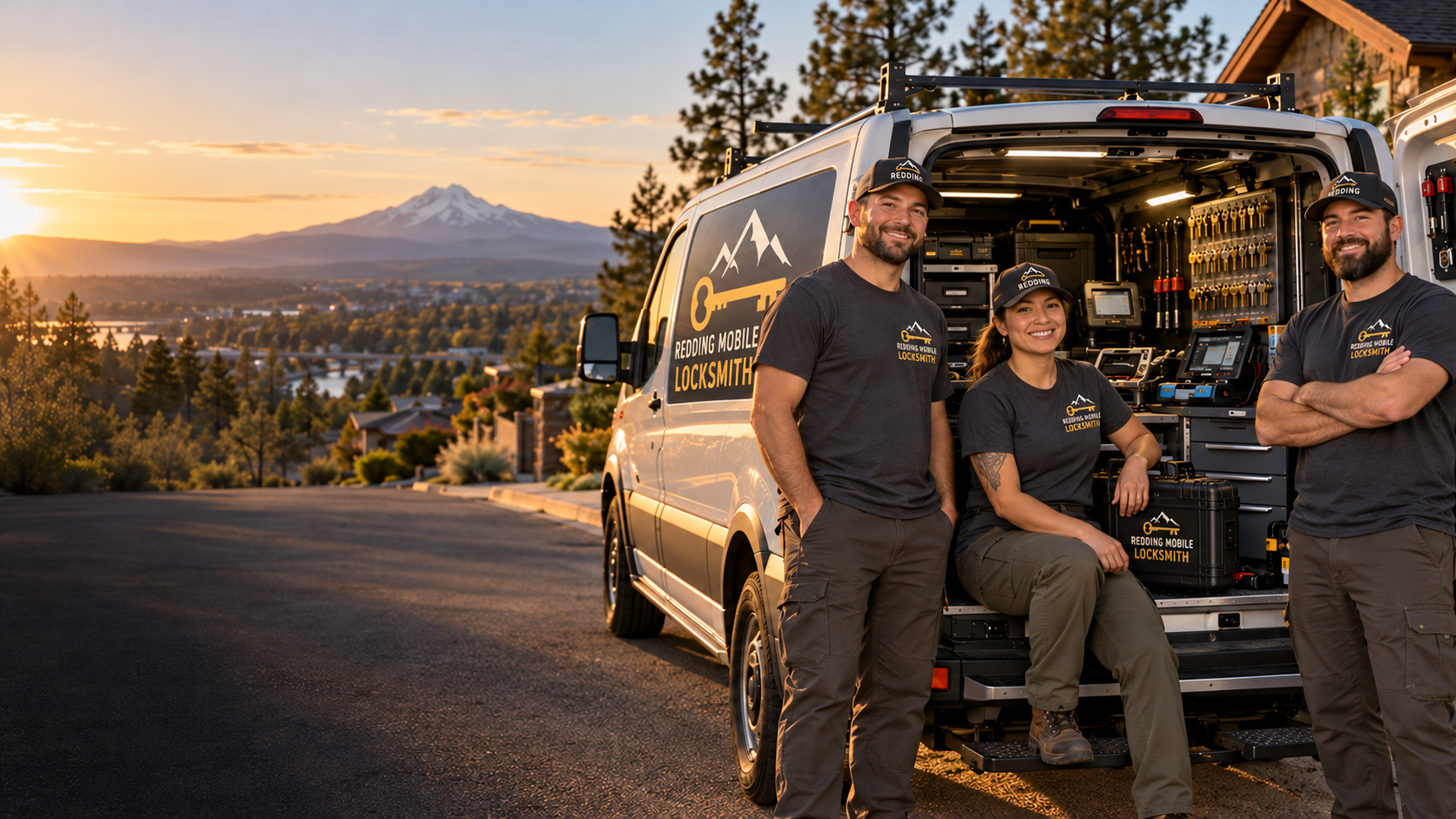
Our branded team arrives in uniform with a branded service van that carries professional tools, key cutting and programming equipment, and common hardware. A van needs a road, and some country roads are better than others. If your drive has deep ruts, a low bridge, a narrow gate or a steep grade, tell us so we can plan how to reach you.
Sometimes the sensible answer is a meeting point. If the van cannot reach the vehicle easily, we may park at a safe spot near the road and carry our tools the rest of the way. If you can meet us at the gate and open it, that saves a lot of confusion. Tell us if the gate has a code or a lock and how to open it. If a dog or livestock is loose on the property, let us know that as well, so our crew can enter safely and without startling animals.
Landmarks help more than street descriptions in rural places. A distinctive mailbox, a gate color, a barn roof or a fence line can be used to confirm that we have the right turn. Stay near your phone, keep your vehicle visible if you can and let us know if anything changes while we travel.
What a professional does at the door
We do not publish bypass methods, and nobody should expect a how to guide here. What we can describe is the general shape of the work. A trained locksmith uses purpose made tools that slide into a gap in the door, protect the paint and the seal, and reach the one point inside the vehicle that unlocks it. Done properly, there is nothing to see afterward.
The key difference between a professional and an improvised attempt is the damage. A coat hanger or a screwdriver can tear weatherstripping, scratch paint, bend a frame or trip a sensor. A professional approach uses wedges and cloths to protect the surface, and works only where the vehicle is designed to be reached.
Vehicles vary, and so does the method. A sedan, a pickup and a van all close differently, and a vehicle with side airbag wiring in the door requires extra care. We explain what we plan to do before we start, and we stop and rethink if the vehicle surprises us.
After the door opens, we check that the lock, window and weatherstripping all behave normally. We hand you the keys if they were inside, or we work with you on a new key if they were lost. Either way, you should drive away with the vehicle in the same condition it was in before the door closed.
Heat, cold and safety while you wait
Waiting is the hard part. In summer, the foothills can be very warm, and a closed vehicle heats up in a hurry. If you are waiting outside, find shade, drink water if you have it, and keep an eye on any animals with you. If the vehicle is locked with a person or an animal inside, call emergency services first, because heat inside a closed car becomes dangerous in short order.
In winter, the problem flips. Cold, wet and early darkness make waiting uncomfortable and sometimes unsafe. If you are far from the house, consider walking to a warmer, safer spot rather than standing by the vehicle in the cold. Let us know where you will be so we can find you.
At any time of year, stay clear of roads and gates where traffic or livestock might be a hazard. If you are on a shared private road, be aware of neighbors who might drive through. Hazard lights, a bright jacket and a clear view of your location make it easier for everyone. If you need to leave the vehicle to get somewhere safer, take your phone and your wallet if you have them, and tell us where you went.
Keys inside a running vehicle on acreage
A running engine with the keys locked inside is common on rural property, where people leave a truck idling while they open a gate or move equipment. A vehicle left running can drain fuel, and some will lock themselves with the key inside. The situation deserves careful handling.
If the vehicle is running, turn on your hazard lights if you can and keep away from the exhaust. Make sure the vehicle is not in gear and cannot roll. On a slope, be extra careful, since a vehicle that moves while locked is a much bigger problem than a lockout. Keep clear of the front and the rear in case the vehicle moves unexpectedly. Then tell us clearly that the engine is running so we plan accordingly.
Our guide on keys locked in a running car explains the risks in more detail, and why some vehicles behave oddly when locked with the engine on.
Preventing the next lockout on a working property
On a property where you are in and out of vehicles all day, a few habits make a big difference. Wear your keys on a clip, a lanyard or a belt loop so they cannot be left on the seat. Use a smaller key ring for daily work and keep the rest at home, so you carry less and lose less.
Think about the pocket as well. Keys that live in a jacket pocket go wherever the jacket goes, and a jacket tossed on the seat takes the keys with it. A dedicated pocket or a clip on the belt means the keys travel with you, not with your clothing. It is a tiny change, and for people who climb in and out of a truck all day it is worth the habit.
Consider a spare key kept in a secure place. A hidden magnetic box on the vehicle is a risky choice, since many people know the trick. A better plan is a spare in the house, with a trusted person or in a lockbox. See hiding a key outside and better options for safer ideas.
If you run several vehicles and equipment, label spares by vehicle and keep a list. Our guide on work trucks and toolbox locks may help with a tidy system. And if your lockout revealed that you have no spare at all, read about car key replacement in Millville.
Other locks around the property
A locked vehicle is often the first sign that your key system needs attention. On a property with a barn, a shop, a well house and gates, you may have a lock for each, and a key for each. A lockout can be a good prompt to count what you have.
Our page on house lockouts in Millville covers the house side of this, and rekeying in Millville explains how to group locks into sets. If a lock has started to stick, see lock repair in Millville.
For the full range of vehicle help, visit our car lockout service page and the automotive locksmith overview. We also serve neighboring Palo Cedro, so if you travel between the two, we can plan around where you are.
Requesting help from Millville
When you are ready, use the request form on the contact page. Include your location in plain words, the vehicle type, where the keys are and any access notes for gates or roads. You do not need to be perfect; a clear sentence on each is enough.
Read more about the area on our Millville page. Whatever the situation, the approach is the same: stay safe, stay calm and give us the information that lets us find you and do the work properly. If your plans change before we arrive, such as a family member showing up with a spare, send word through the form so we can adjust and let the crew move on to the next call.
Common questions
What if my property has a locked gate?
Tell us in your request, and say how the gate opens, whether by key, code or by you meeting us. We can plan around it. If you can meet us at the gate and open it, that saves time. If not, give us as much detail as you can about access.
Can your van reach a long private road?
Often yes, but conditions matter. Tell us about ruts, steep sections, narrow gates or low branches. If the van cannot reach the vehicle, we may park nearby and carry our tools the rest of the way. A clear description lets us plan before we leave.
Will you damage my truck getting in?
Not if the work is done properly. Trained locksmiths use protective wedges and purpose made tools that work with the vehicle's own seals and lock points. Damage mostly comes from improvised tools like coat hangers and screwdrivers, so it is wise to resist trying them.
Do I need to prove the vehicle is mine?
Yes. We confirm ownership before opening a vehicle, usually with a registration and a matching ID. If your papers are locked inside, a photo on your phone or a family member with copies can help. Ask when you send the request and we will explain what works.
What if there is no cell signal at my property?
Signal can be patchy in the foothills. Try from a higher spot or from the house, and send the request form when you have a connection. Give us a clear description of the location so we can find you without needing to call back repeatedly.
How do I request a car lockout in Millville?
Our phone line is coming soon, so please use the request form on the contact page. Tell us where you are, the vehicle type, where the keys are and any gate or road details. That helps the crew arrive prepared for your property.