
One key, three very different jobs
Imagine a college student in Redding who shares a rental car with a roommate and a cousin passing through. One key, three people, and one afternoon when it ends up in a jacket on the wrong side of town. The student does not need a lecture about keys. The student needs to know what kind of key the car uses, what a replacement involves, and what to do next.
That illustration is hypothetical, but the confusion is real. People say "car key" and mean anything from a plain metal blade to a push button fob that never leaves a pocket. What it takes to replace the key depends entirely on which type the car uses, and that decides whether the work is a simple cut or a longer sequence of steps.
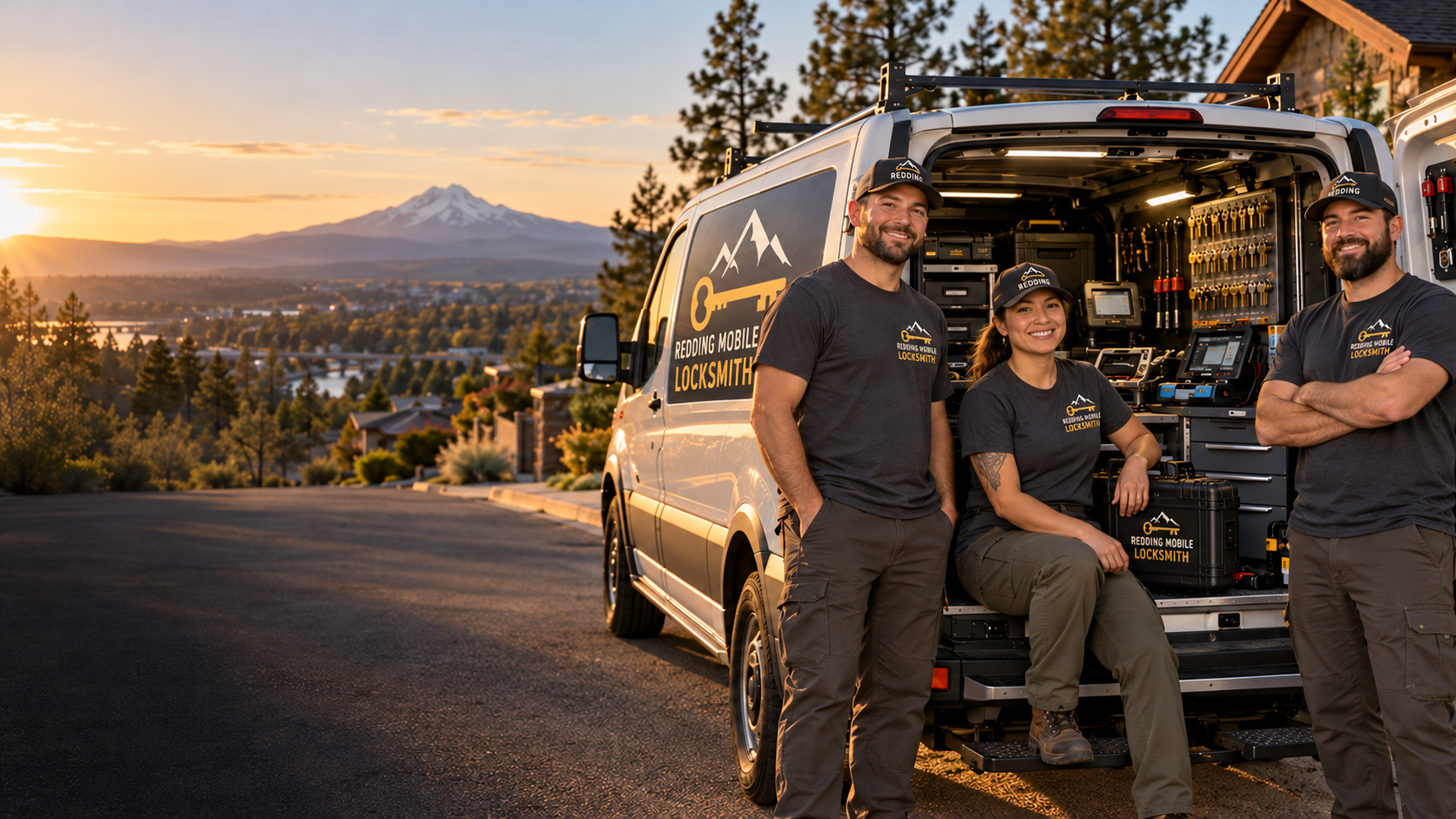
Alpine Dispatch is a 24 hour mobile locksmith based in Redding, with a branded service van and a uniformed crew that carries key cutting and programming equipment. This page walks through the main types of car keys, how replacement differs for each, and what to prepare before you reach out.
The simplest kind: a plain mechanical key
Older vehicles, and some basic modern ones, use a key that is just a cut piece of metal. It turns the ignition cylinder and the door locks mechanically, with nothing electronic inside. If you lose one of these, a locksmith can cut a new key from the lock code or from the existing lock itself, and the car will accept it right away.
Plain keys are easy to copy, and that is both the good news and the caution. Anyone with access to a duplicate can start the car. For a vehicle that is shared among friends or family, that may be fine. For one that carries tools, equipment or valuable items, it is worth thinking about who has copies.
Plain key replacement is the lowest complexity job. Even so, a locksmith needs to confirm that the vehicle is yours and that the key type is what you think it is. Many vehicles that appear old have transponder chips hidden in the head of the key, and a close look at the key head and the vehicle details is the first step.
Another thing worth knowing is that the cut on a key is not the whole story. Keys have a profile, which is the shape of the blade as seen from the end, and a car will only accept a blank with the matching profile. Locksmiths carry a wide range of blanks for this reason, and the van stock covers many common profiles so that a trip to a supplier is not always needed.
Transponder keys and the chip inside
A transponder key looks like a regular key, often with a plastic head, but inside that head is a small chip. When you turn the key in the ignition, the car sends out a signal and the chip answers with a code. If the code matches the one stored in the car, the engine is allowed to start. If not, the car may turn over briefly and then stop, or refuse to crank at all.
That matters for replacement. A transponder key has to be both cut to fit the lock and programmed so the car recognizes its chip. A key blank from a hardware counter that is cut correctly but not programmed will turn the lock and not start the engine. Our field note on transponder keys explained shows how this works in simple terms.
Our van carries the equipment to cut and program many transponder keys on site. Some vehicles are more demanding than others, and the crew will tell you what is involved once they know the make, model and year. The key programming page goes deeper into the process and the kinds of equipment used.
Remote head keys and flip keys
Many keys combine the mechanical blade and the remote lock buttons in one housing. A remote head key has the buttons built into the head of the key, and a flip key has a blade that folds out of a fob. Both usually contain a transponder chip, plus a separate remote circuit that controls the door locks and sometimes the trunk or hatch.
Replacing one of these means handling two systems. The chip must be programmed so the car will start, and the remote must be paired so the buttons work. Those are separate steps, and sometimes the remote functions can be added by following the vehicle procedure while the key is programmed by a tool. A good crew explains which parts are essential and which are conveniences.
If the buttons on a working key have simply stopped responding, the problem may be a dead battery rather than a failed key. Our note on key fob battery basics explains what to try before assuming anything is broken. Sometimes a small battery swap is all that is needed, and the key can stay in your pocket.
If the battery is fine and the buttons still do nothing, the remote portion may need to be paired again. That is a different task from programming the chip, and it is often done with a short procedure at the vehicle.
- Plain key: cut only, no electronics.
- Transponder key: cut and programmed to the vehicle.
- Remote head or flip key: cut, programmed and paired for the buttons.
- Smart key: programmed, with the vehicle accepting a proximity signal.
Smart keys and push button start
A smart key, sometimes called a proximity key, lets you unlock the doors and start the engine without taking the fob out of your pocket. The car senses the fob nearby and allows the doors to open and the start button to work. These systems feel effortless, but they depend on encrypted communication between the fob and the car.
Replacing a smart key is the most involved case. The fob must be programmed to the vehicle, and if every key has been lost, the process may require additional steps to add a new key to the car. Not all vehicles can be handled at roadside, and the crew will be honest about what is possible once they know the model.
Our field note on smart keys and push button start explained describes how these systems behave and what to do if the fob battery fails. If you have only one smart key left, it is worth thinking about a spare before you lose that one too.
One more point worth mentioning is the emergency blade. Many smart fobs contain a small mechanical key that slides out and opens the driver door when the fob battery is dead. Know where yours is and how to use it, and keep it with the vehicle paperwork if you ever need a reminder. It will not start most cars by itself, but it can save you from a lockout.
Lost one key versus lost every key
Replacement is simpler when you still have one working key. A crew can often copy or clone the existing key, or program a new one while the old one is present. If you have lost every key to the car, the job is bigger, because the system must accept a brand new key without a working one to authorize it.
That is not a reason to panic. A locksmith with the right equipment can handle many all keys lost situations on site, though the process depends on the vehicle. Our guide on lost every key, what to gather lists the documents and details to have ready.
If you still have one key, consider this the moment to make a spare. Our note on a spare key now versus later explains why the second key is almost always a smaller job than a replacement after losing everything. Plan for the day you lose the first one, not the day you lose them all.
In a place like Redding, where trips often run to trailheads, lakes and rivers, keys fall out of pockets and into water more often than people admit. A key that has been through a river or a washing machine may still look fine and yet have a damaged chip, so do not trust a soaked key until it has been tested.
What we need to know to help
To replace a car key, we need to know a few things. The make, model and year of the vehicle matter, because key systems vary. We need to confirm that you own the vehicle or are authorized to work on it, which usually means having registration or other documents and your identification. Rules for what counts can vary, so ask when you contact us.
If the vehicle is locked, tell us where it is and whether it is safe to leave. If it has the keys inside, we may need to open it first, which you can read about on our Redding car lockout page. If a child or a pet is in the car, call emergency services first, before anything else.
Take a photo of the vehicle identification number, usually visible through the windshield, and of any key you still have. These details help the crew prepare, including choosing the right blank and the right programming path. You can send it all through the request form on the contact page.
Be ready to share how many keys the car came with and how many you can account for. If one key is out there somewhere, the crew may recommend removing it from the vehicle memory so it can no longer start the car, which is a worthwhile step if it was lost somewhere that someone could find it.
On site versus at a dealership
People often wonder whether to go to a dealership or call a mobile locksmith. A dealership has its own advantages for certain vehicles, and some models do require special procedures. A mobile locksmith's advantage is that the work comes to you. You do not have to tow a car with no working key, and you do not have to arrange a ride.
In Redding, where a car is often the way to get to work, class or the river, being able to handle a key problem in the parking lot or the driveway is a real convenience. The crew arrives in a branded van with cutting and programming tools, and many jobs finish on the spot. If a particular vehicle cannot be done on site, the crew will say so before starting.
This is not a competition. Ask questions, compare options, and choose what fits your situation. We would rather explain honestly what is involved than hold back information. For more on how we handle vehicles in general, see the automotive locksmith page and the car key replacement service page.
Whichever route you take, get clear on what you are being offered. Ask whether the new key will be a full replacement that starts the car and runs the remote, how many keys come with the job, and whether a spare is included in the plan. Those plain questions help you compare options fairly and avoid surprises once the work begins.
Shared cars, rentals and several drivers
Shared vehicles raise their own questions. If a rental or a car owned by someone else is involved, permission matters. A locksmith needs to work for someone entitled to make a key for that vehicle, and in some shared arrangements that person is the owner, not the driver. The student in our illustration might need to contact the owner or the rental company before anything is cut.
Households with several drivers also benefit from a plan. Decide who holds which key, where the spare lives, and who is responsible when something goes wrong. A little organization keeps a small problem small. For businesses running work trucks or a small fleet, our guide on key control for fleet vehicles offers a practical approach.
If your key is damaged rather than lost, such as a cracked head or a bent blade, do not wait for it to break completely. A key that is still working can be copied, but a broken one may not carry the chip or the cuts needed. Keep the pieces if it does break, because they can help the crew.
Related Redding help and next steps
Car keys are often part of a larger situation. If your house key was on the same ring, see our Redding house lockout page and rekeying in Redding for the home side. If you drive for work and keep tools in a truck, you might also read about commercial locksmith help in Redding.
The Redding area spans Interstate 5, Highway 299 and Highway 44, so cars come and go from all directions, and breakdowns happen in all sorts of places. We also cover Anderson, Shasta Lake and the rest of Shasta and Siskiyou counties. The Redding service area page gives the overview.
Our phone line is coming soon, so the request form on the contact page is the place to begin. Tell us where the vehicle is, what kind of key it uses, how many keys you still have, and anything else that seems important. We will take it from there.
Common questions
Can you make a new car key on the spot in Redding?
In many cases yes. Our service van carries key cutting and programming equipment, so a crew can often cut and program a replacement at your location. Some vehicles need additional steps, and the crew will tell you what is possible once they know the make, model and year.
What is the difference between a transponder key and a smart key?
A transponder key has a chip that answers a signal when the key is in the ignition. A smart key lets the car sense the fob nearby so you can unlock and start the car without removing it from a pocket. Both must be programmed, and smart keys are generally more involved.
What if I have lost every key to my car?
It can usually still be handled, though it is a larger job than copying a key you still have. We will ask for the vehicle details and proof of ownership, then explain what the process involves. Call emergency services first if a child or pet is inside the locked car.
Do I need to prove the car is mine?
Yes, a reasonable check is normal. Registration, title or other documents tied to you and the vehicle, along with identification, are common examples. What is acceptable can vary, so ask when you contact us. For a rental or shared car, the owner may need to approve the work.
Can a key with a dead remote battery just be fixed?
Sometimes the buttons stop working only because the small battery in the key has run down. Replacing that battery may restore the remote. If the car still will not start or recognize the key afterward, the chip or the programming may be the issue, and we can look into it.
Should I make a spare key before I need one?
Almost always, yes. Copying or programming a second key while you still have a working one is usually a smaller job than replacing everything after the last key is lost. Keep the spare somewhere safe and separate from the key you carry every day.