
Home / Field notes / A lock strategy for cabins and second homes
Field notes: cabins
A Lock Strategy for a Cabin or Second Home That Sits Empty
A cabin is a house that you are rarely in, which changes almost every lock decision. This guide walks through keys, hardware, seasonal habits and shared access for places you visit but do not live in.
A house that nobody is watching
A primary home has a built in security system: people. Lights come on, cars come and go, a neighbor sees the same faces each week. A cabin or second home has none of that. It sits quiet for weeks, sometimes months, and the locks are the main thing between the property and the outside world. That is a different job from what the locks on a main residence have to do.
The distance matters too. If a lock fails on your main house, you are there to deal with it. If a lock fails at a place you visit twice a season, you may not find out until you pull into the driveway with a car full of groceries. Dependable hardware and a simple routine matter more here than anywhere else.
Throughout the North State, from lake country around Shasta Lake and Lakehead to the high country around Mount Shasta, McCloud and Etna, these places are common and loved. A good lock strategy does not need to be elaborate. It needs to be thought through once, written down, and followed each time you come and go.
Start with who needs a key
Before you think about hardware, think about people. Most cabins end up with a longer key list than anyone planned. A couple owns it, grown children use it, a sibling borrows it, a caretaker checks on it, a cleaner or a handyman has a key, and a former owner might still have one. The more keys in circulation, the less control you have.
Write the list out. For each person, note what they can open, when they use it and whether you want them to keep a key all the time. For people who only need occasional access, such as a repair visit, a temporary arrangement is better than a permanent key. For family, a clear shared rule helps: who may lend a key, and to whom.
If you have just bought a place, assume that old keys are floating around. Previous owners, agents, contractors and caretakers may all have kept copies. This is the most common reason to rekey a cabin, and it costs less and is simpler than replacing every lock. Our rekeying service changes the inside of the cylinders so old keys stop working, and you keep the hardware you already have.
Shared ownership adds a human layer. When siblings or friends own a cabin together, decide early how a lost key is handled, who pays for a lock change, and whether guests may be given a key. These conversations are easier before something goes wrong than after.
Choosing hardware for a place that sits empty
Locks on a cabin should be tougher and simpler than average. Mechanical deadbolts with solid bolts, strong strike plates and long screws into the frame are the foundation. A solid core or well built exterior door is more useful than any lock if the door itself is thin or the frame is weak. The bolt can only be as strong as the wood or metal it enters.
Think about what is easy to maintain. A mechanical lock does not need batteries, and it will work after a winter of cold. Keypad and smart locks have appeal for sharing access, but they depend on batteries that drain slowly while the place is empty and can fail in the cold. If you do use an electronic lock, pick one with a physical key backup, and put fresh batteries in at every visit. Our note on smart locks, promises and practical limits goes through the trade offs.
Match the hardware to the weather. Doors that face the weather need finishes that tolerate sun, moisture and snow, and cylinders benefit from a cover or a small overhang. If you are starting from scratch, our lock installation page explains how we fit new deadbolts, handle sets and strike plates, and what to think about before you buy.
Door hinges deserve attention on a cabin. Three hinges with long screws that reach the stud do more for security than an expensive lock, because a door that can be pried off its hinge side is a door with a weak spot no deadbolt can fix. Check that the hinge screws are long and tight, and that the door does not flex when you push on it.
Every door, not just the front
Cabins rarely have a single entrance. There is often a front door, a back or side door, a deck slider, a garage or shop door, and a basement or crawl space hatch. Each of these is a way in, and the weakest of them sets the level of protection for the whole building. A strong front deadbolt means little if the sliding door has only the factory latch.
Walk the property and look at every opening with fresh eyes. Sliding glass doors need a secondary lock or bar. Windows need working latches, and ground floor windows deserve a closer look. Basement and crawl space doors, which are often forgotten, should have a real lock rather than a simple hook. We cover the common weak points in sliding glass door locks and window locks for older homes.
Do not forget the outbuildings. A woodshed, a tool shed or a boat shed that holds expensive tools and equipment is often a more tempting target than the cabin itself. A decent padlock on a sturdy hasp, with the hasp screws hidden or bolted through, is a reasonable minimum. Our barn, shop and outbuilding locks note covers it in detail.
Keys that are easy to share and hard to copy
If more than a couple of people use the cabin, think about the key type. A plain brass key can be copied at any hardware counter, and once it leaves your hands you cannot control where it goes. A restricted key requires the owner's authorization to copy, which makes it harder for a key to wander. We explain how those work in restricted keys explained.
Another approach is to key all the exterior locks alike, so one key opens everything, from the front door to the shed. That is convenient, and it cuts down on keys. The trade off is that losing one key exposes all the doors. A small master key system lets you give different people different access, for example a caretaker with a key to the main house only. See what a master key system is for how that works.
Whatever you choose, record the details. Keep a note of how many keys exist, who has them, and the code stamped on each key. If you ever lose one, the note tells you how worried to be. A locksmith can use the code and proof of ownership to cut replacements, and it avoids the problem of copying from a worn copy.
Keep in mind that a key code on its own is not a license to copy. A reputable locksmith will want some evidence that you own the property or vehicle before cutting from a code. That is a protection for you, and it is why a written record in a safe place is more valuable than a loose key in a drawer.
- Rekey the locks when you buy a place, since previous keys are unknown.
- Prefer mechanical deadbolts, with a physical backup for any electronic lock.
- Secure every opening, including sliders, shed doors and crawl space hatches.
- Consider restricted keys or a small master key plan if many people have access.
- Keep a written key list with the code stamped on each key.
Opening up for the season
Arrival is the moment when problems show up, so make it routine. On each visit, start from the outside. Look at the door, the frame and the strike for damage or signs of an attempted entry. Check that the lock turns without effort. Take your time, because a lock that has sat unused for months can be stiff, gritty or corroded.
If a lock is stiff, do not force it. Brush out the keyway, apply a small amount of a dry lock lubricant, and work the key in and out. Our piece on lock lubricants, what helps and what hurts shows which products to choose. Test the deadbolt several times to make sure it throws all the way and retracts without catching.
Replace the batteries in any electronic lock, check the smoke alarm and the carbon monoxide detector, and walk through the whole building. If you find evidence that someone has been inside, such as a window left open, a lock that has been tampered with, or something moved, leave and call the proper authorities. Do not go inside alone to check.
Pay attention to the little signs of wear. A latch that no longer clicks, a door that needs a shoulder to close, or a handle that wobbles are all hints that the hardware will fail soon. A cabin is a poor place to find out the hard way, so fix small things during the visit when you have time and tools.
Closing up for the season
Closing is just as important as opening. Before you leave for the winter, lock every door and window and test them. Make sure the deadbolt is fully thrown, not resting halfway. Look at the weatherstripping and the door sweep, since gaps let in snow and animals. A tidy, sealed building is easier to protect.
Think about the key situation before you go. Take your own keys with you and make sure the caretaker has a way in if you have one. If you leave a key with a neighbor or caretaker, give them a clean, labeled copy and not your main set. For shared family cabins, leave a note about who has which key and when it was last checked.
Treat snow and ice as part of the plan. A lock that is exposed to the weather all winter can freeze, and a snow load can bend a gate or a door. Consider a lock cover for exposed padlocks, and keep a dry lubricant for the first visit in spring. Our note on winter lockouts and frozen locks in the mountains goes deeper on the cold weather side.
Caretakers, neighbors and visitors
Many owners rely on a caretaker, a neighbor or a property manager. That can work well if it is clear and written down. Decide what the person is allowed to do, whether they may let others in, and how you want to be told if something is wrong. Give them the minimum access they need.
If you use keypad locks or a smart lock, you can give each person a separate code and remove it when the arrangement ends. That is easier than collecting keys. Keep in mind that codes should be changed regularly and removed when someone leaves, and that the lock still needs its batteries checked. Our keypad locks for rental turnover note describes good habits.
If the cabin is occasionally rented out, the access plan changes again, because strangers will have the code or key. Our securing a vacation rental with keys and keypads guide covers that case. Rules about rentals, insurance and local requirements vary, so check with the relevant parties before you decide.
Seasonal workers and visitors bring their own questions. If a firewood delivery, a propane visit or a snow removal contractor needs to reach a gate or a shed, think about how to let them in without handing over a house key. A separate key for an outbuilding, or a lockbox at the gate, keeps the cabin itself out of the picture.
Hunting season, guests and the unexpected
Cabins often get their heaviest use in short bursts. A hunting season weekend brings extra people, extra gear and extra keys. Boots, trucks and firewood go in and out, and doors are used far more than usual. That wear shows up in latches and handles, so a short check before and after is worthwhile. See hunting season cabin access and key care for more.
Plan for the unexpected as well. Picture a family arriving after dark to find the key will not turn, or a guest who locks the only key inside the cabin. A spare key in a safe place elsewhere, held by someone you trust, can save an evening. If you are stuck and no one has a spare, a locksmith can open the door and cut a new key on site.
It also pays to know where to find help. Our team is based in Redding and serves the whole region, including Mount Shasta, Lakehead and McCloud, and our house lockout service covers cabins as well as primary homes. Send a request through the request form and tell us the town.
Wear and tear is simply part of a busy weekend. Latches get slammed, deadbolts get thrown from the wrong side, and key rings get dropped on a gravel driveway. A key that is bent or a latch that no longer lines up is a small thing in September and a bigger one once the snow arrives.
Pulling it together into a plan
A lock plan for a cabin comes down to a short list of decisions. Who holds keys, and how many exist. Which locks protect the openings, and whether they suit the weather. How you open and close each season. Who is your backup if something goes wrong. Write the answers down and keep a copy at the cabin and a copy at home.
Revisit the plan when something changes. A new owner, a new caretaker, a new door, or a lost key is a reason to update. At those moments, rekeying or replacing a lock is usually a small job compared with the worry it removes. Our residential locksmith page covers the services in one place.
A cabin should be a place of rest, not a source of low level worry. With sound hardware, a short key list and a routine you actually follow, the locks do their job quietly, and you can spend your visits on the lake, the trail or the porch.
Common questions
Should I rekey a cabin I just bought?
Yes, in most cases. You cannot know how many keys the previous owners, agents or contractors kept. Rekeying changes the inside of each cylinder so old keys stop working, and it is usually a smaller job than replacing locks. You end up with new keys that you control.
Are smart locks a good idea for a cabin?
They can be, with care. They make sharing access easier, but they depend on batteries that drain slowly while the place sits empty and can fail in the cold. Choose a model with a physical key backup and put in fresh batteries at every visit.
How many keys should a second home have?
As few as your family can manage. Count the keys, record who holds each one, and note any code stamped on them. A small, known set is easier to control than a large, uncertain one. If many people need access, consider restricted keys or a simple master key plan.
What should I do if I suspect someone has been in the cabin?
Do not go inside alone. Leave, move to a safe place and call the proper authorities. Once they have checked the property, a locksmith can repair or replace damaged locks and rekey the doors so that any stolen or copied keys no longer work.
How do I protect outbuildings and sheds?
Use a sturdy hasp with hidden or through bolted screws and a weather tolerant padlock with a shielded shackle. Check the door and frame as well, since the lock is only as strong as the wood around it. Treat tool sheds and boat storage as seriously as the cabin.
Can you come out to a remote cabin?
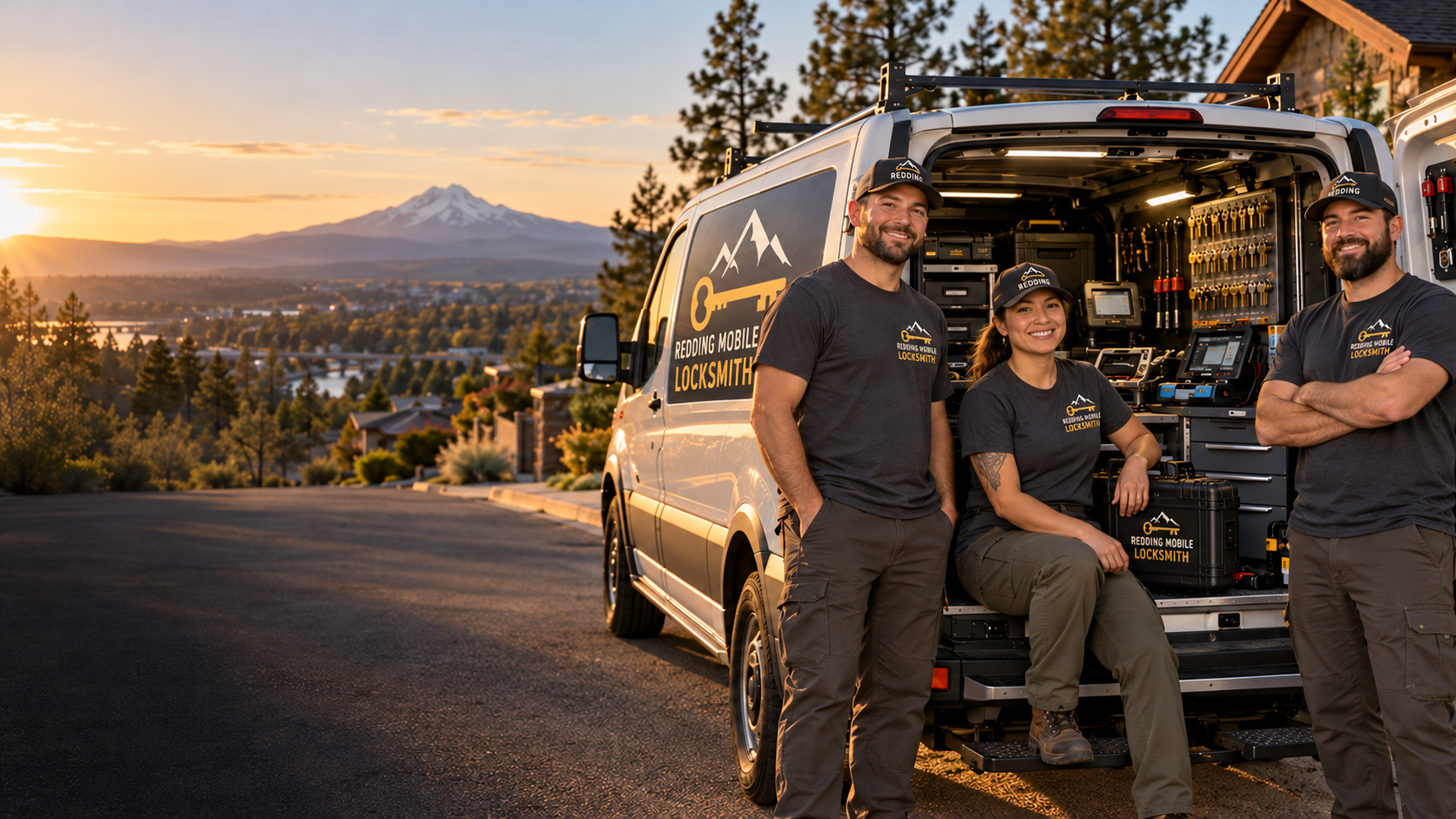
We serve Shasta County and Siskiyou County, including many mountain and lake communities. Send a request through the contact page with the town and what is wrong, and we will talk through the next step. Our van carries tools, key cutting and programming equipment and common hardware.