
Home / Field notes / Barn, shop and outbuilding locks
Field notes: outbuildings
Locking a Barn, Shop or Outbuilding That Holds Real Work
The buildings out back often hold the tools, fuel and equipment that keep a place running. They also have the oddest doors. This guide covers sliding barn doors, roll up doors, hasps and key habits.
The buildings that hold the work
On a lot of North State land, the house is the smallest part of what needs protecting. The barn holds feed, tack and equipment. The shop holds welders, saws and a lifetime of tools. A shed holds the mower, the chainsaw and a stack of fuel cans. A storage building holds everything that will not fit anywhere else. Taken together, they are often worth more than the house.
They are also easier to reach. Outbuildings sit away from the road, away from the house, and often out of sight. They have older doors, thin frames and simple latches, because they were built to keep the weather out, not people. A thief who knows this will go to the shop before the house door.
Good locks for outbuildings do not have to be fancy. They need to match the door, resist tools that are easy to carry, and be simple enough that you will actually use them. That starts with understanding how each kind of door really works.
Sliding barn doors
A big sliding barn door hangs from a track and rolls sideways. It is held in place by a latch, a hook or a hasp, and the locking point is often a single padlock. The weak points are the track, the guide at the bottom and the latch itself. If the door can be lifted off the track or pushed out at the bottom, a padlock on the latch will not stop anyone.
Check the track first. Brackets should be through bolted, and the end stops should be strong so the door cannot be rolled off the end. Add a guide at the floor so the door cannot swing out. Then secure the latch with a hasp that bolts through the door and the frame, with the screws hidden when the lock is closed.
Where the door slides past a fixed one, a hasp is often fitted across the gap. Use a heavy duty one and a padlock with a shrouded shackle, and keep the hasp tight against the wood so there is no room to pry. For a barn you use daily, a hook and eye that is easy to flip open is a convenience, but it is not a lock. Treat it as a latch and add a real lock for the times you are away.
Picture a barn door on a windy afternoon. A latch that is only a hook can rattle loose, and a door left unsecured can bang against the track until it bends. Even a simple pin or bolt that holds the door against the wind is useful, and it keeps animals in or out as well.
If the barn doubles as a workshop, think about the dust. A track packed with hay dust and chaff makes the door harder to slide and tempts people to leave it open. A short brush down the track each season keeps the door light on its rollers and the lock lined up.
Roll up and overhead doors
Shops and metal buildings often have a roll up or sectional overhead door. These doors can be locked in a few ways. A slide bolt, built into the track or the door, drops into a hole in the track and stops the door from lifting. A padlock through the track next to a roller has the same effect. A cylinder lock on the door pulls a bar across.
Most of these are simple, which is fine, but they have weaknesses. A thin sheet metal door can be bent. A bolt that is not fixed to anything solid can be defeated. A padlock hanging on a track is only as strong as the roller it sits against. If an electric opener is installed, remember that a locked door will not open if the opener tries to lift it, and the opener may be damaged.
Think about the release handle and cord on a garage door opener as well. A cord left hanging can be manipulated in some setups. Our guide to garage entry door security covers how overhead doors and the entry door beside them work together.
Another point is the tracks and torsion springs on a sectional door. These are under heavy tension and are not a do it yourself project. If the door is sagging, rubbing or noisy, have a qualified door technician look at it, because a door that does not close fully cannot be locked properly.
The man door beside the big one
Almost every barn and shop has a small walk through door, and it is usually the easiest way in. Many are thin hollow or light wood doors, with a basic knob lock and a flimsy frame. The latch on these doors is often the only protection, and a single hard kick will break the frame around the strike.
Strengthening a man door is usually worth the effort. A solid door, a grade appropriate deadbolt, a longer strike plate with long screws that reach the framing, and a reinforced frame make the door much harder to force. Hinges should be sound, with screws long enough to reach the studs. Our note on choosing a deadbolt grade in plain words explains how to pick one.
A weatherproof deadbolt is better than a knob lock for an outbuilding, but make sure it is made for outdoor use. Keep it clear of sawdust, hay dust and moisture, which collect in a barn. Our lock installation page describes how we fit and upgrade these doors.
Think about the door swing, too. A man door that opens outward exposes its hinges, so the pins should be fixed or the hinge should be a security type that cannot be lifted off. A door that opens inward is harder to kick in because the frame supports it, but the strike must be set into solid wood.
- Strengthen the frame and the strike plate before buying a stronger lock.
- Use a deadbolt rather than a simple knob lock on a man door.
- Bolt hasps through the door and frame with the screws hidden when locked.
- Fit a guide at the bottom of a sliding door so it cannot swing out.
- Keep locks clean of sawdust, hay dust and moisture.
Hasps, staples and padlock positioning
A hasp is a hinged strap that folds over a staple. It is a common way to lock a shed or barn door, and it is only as strong as its mounting. Screws driven into thin trim can be pulled out by hand. Choose a hasp with a concealed fixing, a hasp that bolts through the door, or a heavy duty model with a solid cover for the screws.
Position the padlock so that it is hard to attack. A lock resting against the door frame has little room to be struck or cut. A lock hanging loose gives a tool room to work. A shrouded padlock tucked behind a hasp cover is harder to get at. Where possible, place the hasp so that the keyhole faces down.
Consider how often you will use the lock. A door you open every day wants a lock that is easy to use and simple to replace. A door you open twice a year can have a heavier arrangement. Whatever you choose, test it by trying to defeat it yourself with the tools you have on hand, and fix whatever gives.
Windows, vents and the forgotten openings
Barns and shops usually have windows, vents, loft doors and hatches. A loft door that opens from the outside with a simple latch is an invitation. Fix a latch on the inside, or a bar that holds it shut. Windows can be screened, covered with a bar or grille, or fitted with security film and a sound latch.
Do not forget the fan door, the pet door and the hay door. Each is a hole in the wall that was cut for a reason and often forgotten. A pet or animal door that can be reached by hand is a way in. Seal it when it is not in use or put a lock on the inside of the door.
Our notes on window locks for older homes apply to older outbuildings too, since the hardware is often similar. Walk the whole building at night with a flashlight and look for anything that could be opened from the outside.
Safety first: animals, chemicals and children
A lock is also a safety tool. Fuel, pesticides, solvents and sharp equipment should be out of reach of children and animals. A separate locked cabinet or room inside the shop is a good way to protect them, and it gives a second layer if the building itself is breached.
For barns with animals, think about how the doors work from the animals' point of view and from your own in an emergency. A stall door that cannot be opened with ease in a fire is a danger. Latches should be simple enough to open in the dark, with gloves on, by someone who has never used them. Safety latches that animals cannot work themselves are widely available.
If you share the property with guests, family or workers, think about which buildings they may enter and which stay locked. A lock is the clearest way to say a space is off limits. It protects them as much as it protects your equipment.
Remember that the nicest lock in the world cannot make up for a door that is left open. Habit counts for more than hardware. Make it a rule that the last person to leave locks up, and put a visible reminder by the door. A hook for the key just inside the house door helps it get back where it belongs.
Keys, codes and who has access
Outbuildings tend to accumulate keys. A hired hand, a neighbor who feeds the animals, a contractor who borrowed a key last spring and never returned it. Over time no one remembers who can open what. A simple key log, with the name of each person and what they have, makes that manageable.
A keyed alike set can reduce the clutter, with one key for the barn, shop and shed. A master key system gives the owner a key to everything and gives others access to only the buildings they need. Our guide on what a master key system is explains the idea.
When a key goes missing or someone leaves, rekey. It is much simpler than replacing every lock and does not change the hardware. Our rekeying service resets the cylinders so old keys stop working. A combination lock can be changed in seconds, but make sure the new combination is not shared too widely.
Tools, fuel and the things thieves look for
Rural thieves target what is easy to sell: power tools, chainsaws, generators, welders, fuel and copper. Think about what you have inside and how visible it is. Equipment on shelves near a window is easier to spot than a cabinet in the back. Locking valuable tools in a cabinet, a chest or a small safe adds a second barrier even if the building is breached.
Keep a list of your tools with serial numbers and a few photographs. Mark them with your own identifying mark. If something is stolen, that record helps everyone involved. Store the list somewhere other than the shop itself.
Lighting helps. A light on a motion sensor over the door draws attention and removes a thief's cover. Keep brush and tall grass cut back from the building so there is nowhere to hide. Our home security walkthrough, lock edition uses the same approach for houses, and you can apply it to the shop with small changes.
Keep your insurance and neighbors in mind. Some insurers ask about locks on outbuildings, and requirements vary, so it is worth asking your own agent what they expect. Neighbors who know your routine can notice when something is out of the ordinary, and a friendly word about keeping an eye out costs nothing.
Care and maintenance in dust and weather
Barns and shops are dusty places. Hay dust, sawdust and fine grit settle into keyways and hasps and gum up with oil. Wipe locks clean, use a dry lubricant and avoid heavy grease. Our piece on lock lubricants, what helps and what hurts explains why.
Weather does the rest. Hot dry summers shrink wooden doors and frames, and cold wet winters swell them. A door that closes well in July may bind in January. Check that hinges and strikes are tight, that the door closes without lifting, and that the latch lines up. Repair what is loose before it fails.
If a lock does fail, our lock repair service can fix or replace it. For commercial style hardware on larger shops, our commercial door hardware page describes what we handle.
Getting a second opinion on your buildings
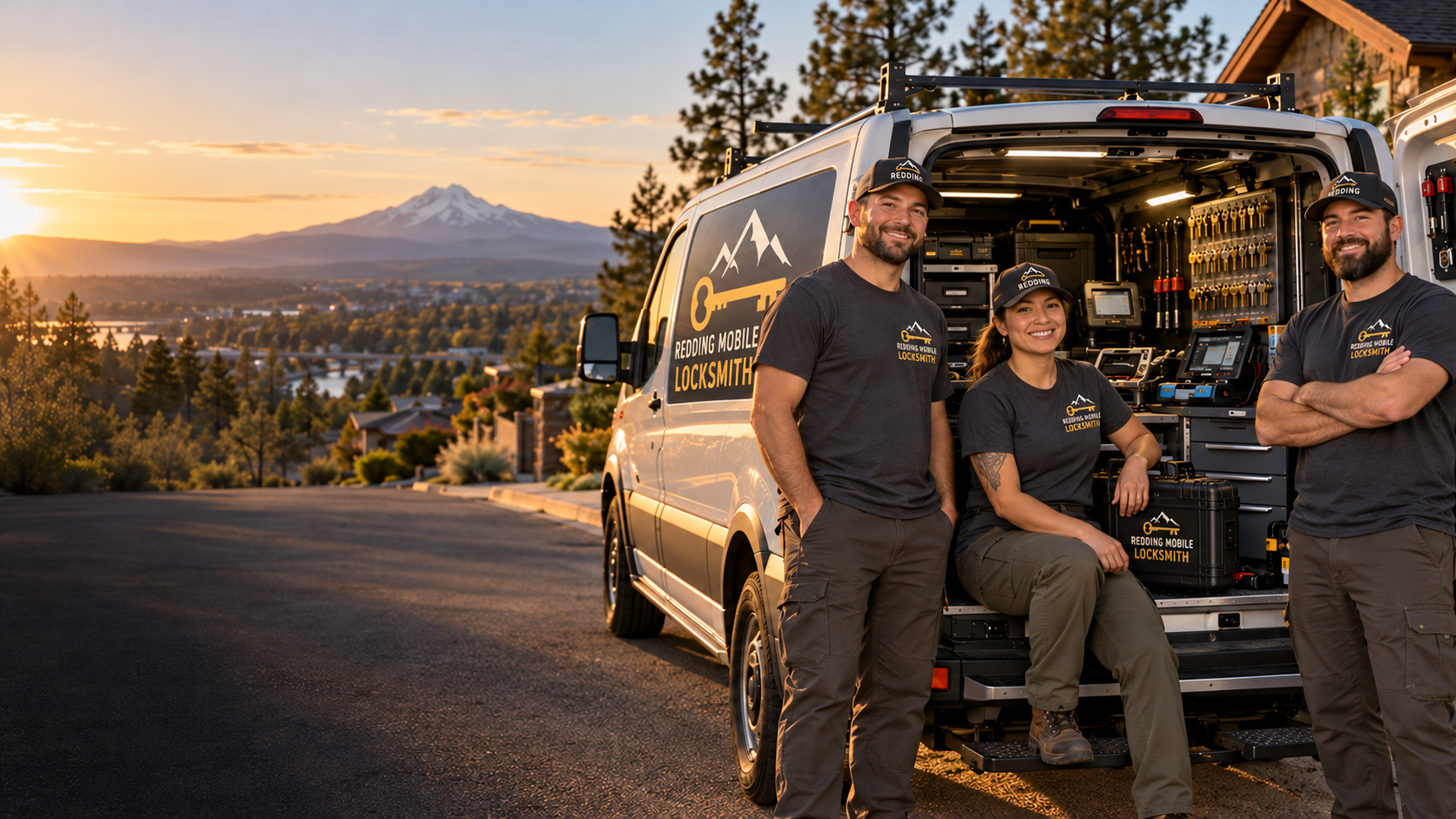
Sometimes it helps to have someone look at the buildings with fresh eyes. We can walk through the doors, windows and latches, point out the weak spots and suggest fixes that fit your budget and your use. Our team arrives in uniform in a branded service van with professional tools, key cutting and programming equipment and common hardware.
If you have a lockout, a lost key or a damaged lock at a barn or shop, tell us what you have and where it is. We serve Shasta County and Siskiyou County, from the valley around Redding to the mountain towns, and many of our calls are on rural land.
Send a request through the request form. The phone line is coming soon. Include your town, the kind of building and the kind of door, and we will help you plan the next step.
Common questions
How do I lock a sliding barn door?
Secure the track and add a floor guide so the door cannot be lifted or pushed out, then fit a heavy hasp bolted through the door and frame. Use a shrouded padlock and keep the hasp tight against the wood. A hook and eye is a latch, not a lock.
Which lock suits a shop man door?
Start with a solid door and a strong frame, then add a deadbolt made for outdoor use with a long strike plate and long screws that reach the framing. A stronger lock on a weak frame protects very little, so reinforce the frame first.
How can I secure a roll up shop door?
Use a slide bolt or a padlock through the track so the door cannot be lifted, and make sure the fixing is solid. Thin sheet metal can be bent, so consider reinforcement. If you have an opener, release it properly when the door is locked.
Should all my outbuildings use the same key?
It is convenient and reduces clutter, but losing one key exposes everything. A master key system lets you open every building while giving others access to only the ones they need. Keep a written log of who holds each key.
How do I protect tools inside a shop?
Lock the most valuable tools in a cabinet or chest, keep serial numbers and photos in a safe place, and use lighting and tidy surroundings to remove cover. Layers matter: a locked building, a locked cabinet and a record of what you own.
Can you work at a barn or shop that is far from town?
Yes. We serve Shasta County and Siskiyou County, and our van carries tools, key cutting and programming equipment and common hardware. Send a request through the contact page with your town, the building and the problem, and we will plan the visit with you.