
A key that did not come back from the river
Picture an angler walking back to a Siskiyou County trailhead at dusk. The light is low, the truck is at the end of the gravel, and a hand goes into a jacket pocket for the key ring. It is not there. Somewhere between the water and the parking area, a ring with a truck key, a house key and a shop key slipped out of a pocket and into the brush.
The first thought is usually about the truck. The second, a little later and a little colder, is about the house. Someone out there now holds a key that opens a door, and the owner has no way of knowing who finds it. That is the moment people start asking about rekeying.
This page is for that situation and for the others like it. It explains what rekeying is, why it is usually the sensible response, and how a visit works for homes and small businesses in and around Weed.
There is a lesson in that story for anyone who spends time outdoors around Mount Shasta, the Klamath country and the rivers and lakes of the north state. Keys travel in pockets, in packs, in boats and on belt loops, and they get lost in places no one will ever search again. Planning for that before it happens is easier than reacting afterward.
What rekeying actually does
A common pin tumbler lock has a cylinder with a row of small pin stacks. The key lifts each stack to a precise height, and when every stack lines up at the shear line, the cylinder turns and the bolt moves. Rekeying changes the pins inside the cylinder so a different key cut matches it. The old key still enters the keyway but no longer lifts the pins correctly, so it will not turn.
Nothing about the outside of the lock changes. The knob, the deadbolt, the lever and the faceplate remain the same. You keep your hardware and your finish, and you receive new keys that fit the new pin arrangement.
This is why rekeying is a favorite among locksmiths and homeowners alike. It addresses the risk, which is an unknown key in the world, without paying for new hardware you did not need. Our full rekeying service page goes deeper into the mechanics.
It helps to picture the inside of the lock as a locked gate with several latches. Each pin is one latch. A key that does not match any one of them keeps the gate closed. Changing the pins is like changing which heights each latch will accept. A thief with an old copy of the key finds that every latch now sits at the wrong level.
Four common reasons people rekey
The first is a move. When you take over a home, you cannot know how many copies of the old keys exist. Previous owners, contractors, cleaners and relatives may all have had one. Rekeying on day one resets the count to zero and gives you the only working keys.
The second is a change in a household. After a breakup, a roommate leaving or a family conflict, an old key in the wrong hands is a risk. The same applies when a tenant moves out of a rental and you want the next one to start clean. Rekeying between tenants is routine for property owners who want a clear line between one occupant and the next.
The third is a lost key, as in our angler's story. The fourth is a small business that wants control after a staff change. In every case, the underlying idea is the same: the locks stay, the old keys stop working.
Rules about tenants and landlords vary, and we do not give legal advice. If you rent out a property, ask your own advisor what your agreement requires. We can tell you what the lock work involves so your conversation is informed.
Some people wonder whether they should simply wait and see if a lost key turns up. That is a reasonable thought for a key that fell behind furniture at home. It is a weaker plan for a key lost outdoors, in a vehicle, at a gym or in a public place. The cost of waiting is a door that anyone could open, and the cost of acting is a short visit.
Rekey or replace
Rekeying is not always the right answer. If a lock is worn, damaged, bent or of very low quality, putting new pins in it simply prolongs a weak point. If a deadbolt has been forced, its bolt or strike may be compromised, and replacement is the more honest option.
On the other hand, a solid lock in good condition rarely needs to be replaced just because keys have been lost. A new set of pins gets the result you want at much less trouble. Our guide to rekeying or replacing walks through the decision in detail.
A technician looks at the lock before recommending either. They check how smoothly it turns, whether the latch lines up with the strike, how worn the keyway is and whether the cylinder is a type that can be rekeyed on site. Honest advice is part of the job, and it is better to hear it before you pay than after.
There are also practical limits worth knowing. Some high security cylinders, sealed locks and certain electronic units are not designed to be rekeyed on site, and the honest answer for those may be replacement. A technician will tell you if your lock is one of those, and will explain what the alternative looks like before any work begins.
What happens during a visit
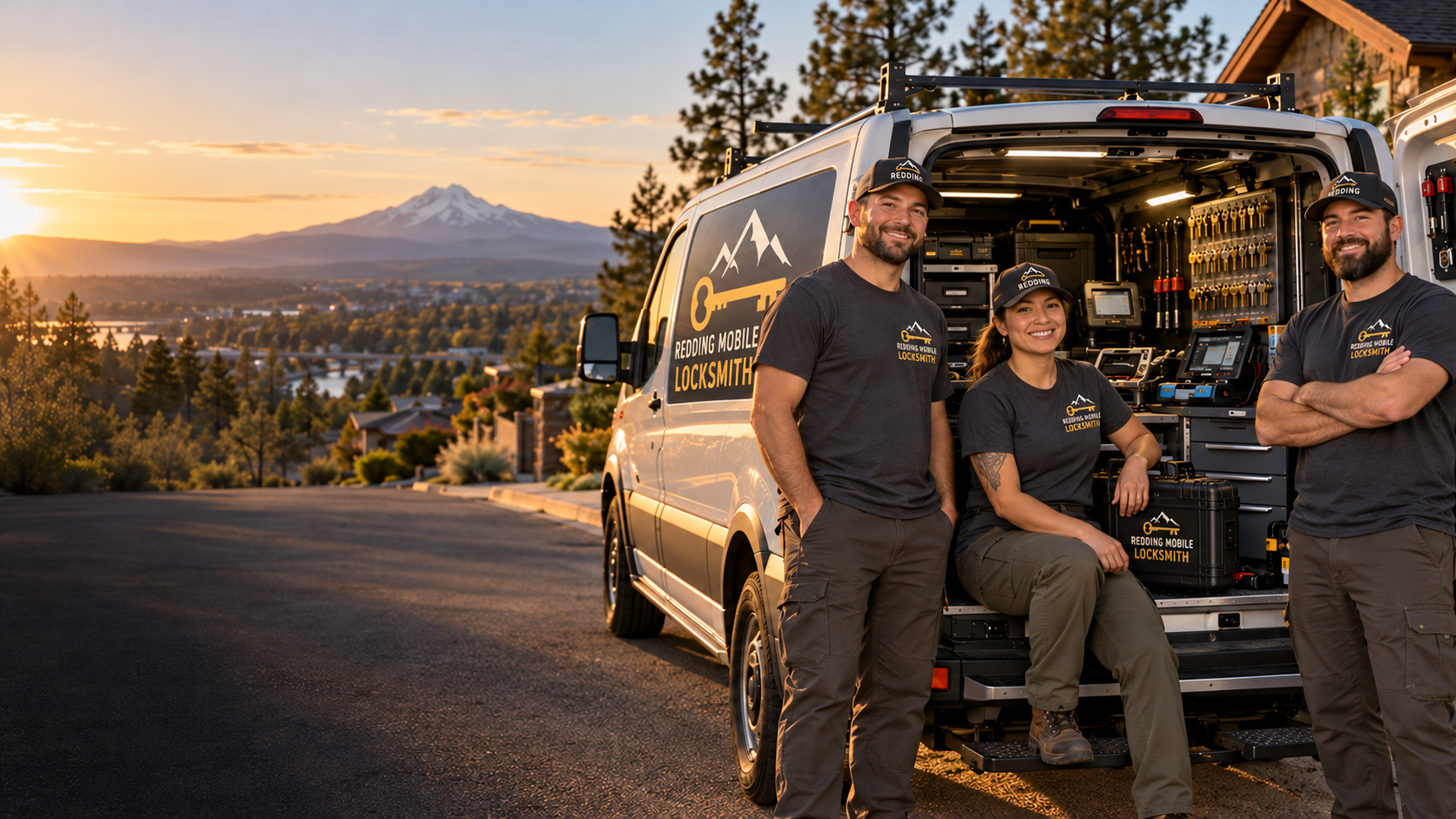
The technician arrives in a branded van carrying key cutting equipment, a set of pins and the tools to remove a cylinder safely. We start by confirming that you are entitled to have the locks changed, which usually means ID and a connection to the property. We then identify the locks to be rekeyed and ask how many keys you want and whether you want the locks to share one key.
Each cylinder is removed, opened and fitted with new pins to match the new key. The cylinder is reassembled, tested with the new key, tested with the old key to confirm it no longer works, and reinstalled. The technician repeats this on each lock in turn.
Once finished, you receive the new keys and a chance to try each lock. The work usually leaves no visible mark, which is part of the appeal. Your door looks as it did, but the keys that used to open it are now useless.
Keep in mind that a technician needs the cylinder to come out cleanly. Locks that are painted over, corroded or set into a swollen door can take more effort. If your hardware is in rough shape, mention that when you book so the visit is planned properly. A little extra patience at the start saves a lot of frustration at the end.
For a home or a shop in Weed, the whole process is often finished in a single stop, because the van already carries the pins, tools and key cutting machine that the job needs.
One key for every door
Many households and small shops end up carrying a ring of keys for the front door, the back door, the garage entry and a shed. Rekeying lets us arrange for several locks to use the same key, provided the locks accept the same keyway or can be matched. The convenience is real: one key, many doors.
Combining keys has trade offs. A single key that opens everything means one loss exposes everything. Some owners prefer to keep the front door separate from the shop or the outbuilding. We can talk through which pairing makes sense for your property.
In a small business, a more structured arrangement sometimes helps, such as one key that opens only the front and another that opens the office as well. A master key system is a more formal version. Our guide on what a master key system is explains the idea in plain words.
Small businesses sometimes want a record of who holds which key. A simple paper list kept in a safe place is enough for many shops. When a worker leaves, you can collect the key, check it against the list and decide whether the lock needs to be rekeyed. That habit turns a vague worry into a clear routine.
Weed homes, shops and outbuildings
Weed has older homes with long used hardware, newer builds with modern deadbolts, rental properties near campus, small shops along the main routes and outbuildings across the open ground. Each brings its own locks. A cylinder on a very old door can differ greatly from one on a newer entry set.
Outbuildings deserve a mention. A shed, a barn or a workshop often holds tools and equipment that are costly to replace. Their locks are sometimes light duty padlocks or old hasps, and the keys have been floating around for years. Rekeying or replacing those locks is easy to overlook and worth considering after any key loss.
Wind, dust and weather work on exterior locks in this area. A lock that is rekeyed is also cleaned and tested, which can bring back smooth operation. Our companion page on lock repair in Weed describes what we look for when a lock is struggling.
If you are an owner with several properties, standardizing across doors can simplify life but should be done thoughtfully. A rental, a home and a shop can each have their own key, with a single master held by you. That way a tenant's lost key never exposes anything beyond their own door. It takes planning, and we are glad to help with it.
Getting ready for the visit
A little preparation shortens the work. Gather every lock you want rekeyed and note which doors they belong to. Find all the keys you have, even the old ones, because bringing them lets the technician test each lock thoroughly. Decide how many new keys you want and who will hold them.
If you are a renter, make sure you have permission before work begins. If you manage a property, be ready to show that you have the authority to change locks. We cannot rely on a verbal claim alone, for the same reason a bank would not.
Last, think about timing. Rekeying a whole house takes longer than one door, and a business with several doors takes longer still. Tell us how many locks are involved when you write your request, and the technician can plan accordingly.
A few homes in the area have deadbolts that were installed by different people in different decades, so the keys do not match from door to door. Rekeying is a good moment to tidy that up. Instead of carrying four unrelated keys, you can end up with two. Fewer keys means fewer chances of losing one.
After the new keys arrive
Keep the new keys on a ring you control and give copies only to people who truly need them. Avoid tagging a key with your address, and avoid leaving a copy in a hiding place that is easy to guess. Our guide on storing spare keys safely has ideas that work better.
Make a habit of confirming that each door locks and unlocks smoothly with the new key. If anything feels off, tell us soon. A fresh rekey should work as smoothly as a new lock.
If you also want a spare for your vehicle or a duplicate for a family member, ask while we are on site. Our team can often handle a house key and a car key in the same visit. For vehicle concerns, see our Weed car key replacement page.
Finally, think about writing down the date of the rekey. When the next change of tenant, move or key loss comes up, you will know how long the current keys have been in circulation. It is a small note on your calendar or in a drawer, but it makes the next decision easier and gives you a reason to check who holds what.
How to book and where we work
Weed is one of seventeen communities we serve across Shasta County and Siskiyou County. Nearby, the same team covers Mount Shasta, Montague and the broader Weed area.
Our phone line is coming soon, so the request form is how you reach us now. Visit the contact page and describe your property, how many locks you have in mind and why you want them changed. Redding Mobile Locksmith will follow up with next steps.
If you are also dealing with a lockout, our Weed house lockout page explains how that call works, and our broader residential locksmith page lists everything we do for homes.
If you are still unsure after reading this page, send the request anyway and describe your doubt. A short note such as I lost a key at the river and have two exterior doors is plenty. We would rather answer a question before the visit than have you guess which service you need.
Common questions
Does rekeying mean replacing my locks?
No. Rekeying keeps your existing hardware and changes the pins inside the cylinder so a different key fits. You keep your knobs, deadbolts and levers. Replacement means removing the lock and installing a new one, which is only needed when the lock is worn, broken or of a type that cannot be rekeyed.
Will my old keys still work afterward?
No, that is the point. Once the pins are changed, the old key enters the keyway but cannot lift the pins to the right height, so it will not turn. The technician tests this with your old key before reinstalling the cylinder, so you can see the result for yourself.
Can all my doors use the same key?
Often yes, as long as the locks accept the same keyway or can be matched. A single key is convenient but means one lost key exposes every lock. Some owners keep the main door separate from a shop or shed. We can talk about the options when we see your doors.
Do I need to be home during the work?
You or someone with authority over the property should be there. We need to confirm that you can approve changes, and you will want to test each lock with its new key. If someone else will be present, tell us in the request so the technician knows who to expect.
Is rekeying worth it after a single lost key?
It often is, especially if the key carried any identification or was lost somewhere another person could find it. A key lost outdoors, with no way to know who has it, is a strong reason. A key that you know slipped behind a couch may not call for it.
Can you rekey a padlock or a garage lock?
Many padlocks and other cylinders can be rekeyed, while others are sealed and need replacement. Tell us what type of lock you have and, if you can, send a short description in your request. The technician will bring the right parts and confirm what is possible on site.