
Home / Shasta Lake / Commercial Locksmith in Shasta Lake
Shasta Lake business doors
Commercial locksmith help for Shasta Lake businesses
Shasta Lake shops, offices and small properties run on doors that open and close all day. We bring a service van, cutting and programming equipment and common hardware to the building, so the work happens where the door is.
A contractor, a work truck and a job site
Picture a contractor who keeps a work truck loaded with tools, runs a small office out of a rented unit, and leases a fenced yard for materials. In one week that person has a front door, a side door, a roll up gate, a toolbox, a truck cab and a storage cage to keep track of. Each of them has its own key, and every key has been copied at least once. This is the real shape of commercial lock trouble in Shasta Lake: not one big system, but a dozen small ones that grew without a plan.
Our job on a call like this is to look at the whole set of openings, not only the one that is failing today. We ask which doors matter most, who holds keys, and which keys have wandered off. Then we decide what can be repaired, what can be rekeyed and what should be replaced.
A commercial call is often a mix of urgent and routine. The urgent part is the door that will not lock tonight. The routine part is everything we notice while we are there, which we write down in plain words so you can decide what to do next. You can describe your situation through the request form and we will take it from there.
- Count every door, gate, cage and cabinet that takes a key.
- Write down who holds a key to each one today.
- Note which locks are original and which have been changed.
- Mark the opening you could not leave unlocked overnight.
Why Shasta Lake properties have a mix of locks
Shasta Lake sits along Interstate 5 close to Shasta Dam and Lake Shasta, so the town serves families, renters, lake visitors and people who commute to Redding. That mix shows up in the buildings. A small strip of shops, a repair garage, a storage yard, a rental office and a home business can all sit within a short stretch of road, and each was set up by a different owner at a different time.
The result is hardware that does not match. One door has a heavy duty deadbolt and a closer. The next has a light residential knob that was never meant for a business. A back door might have a chain, a padlock and a lock that nobody has a key for. None of this is unusual, and none of it is hard to fix once someone lists it.
When we arrive we look at the door, the frame and the hardware as one assembly. A strong lock on a weak frame is not strong. A good lock with a loose strike is a lock that fails on the first cold morning. We explain what we see in terms you can repeat to a partner or landlord.
Key control: the quiet half of commercial security
Key control means knowing who can open what, and being able to change that on purpose. Most small businesses do not have it. Keys get handed to a helper for a weekend, copied at a hardware counter, and never collected. After a season, nobody can say how many keys exist.
The practical fix is a small written list and a decision about which locks should be rekeyed so that old keys stop working. Rekeying changes the internal pin or wafer arrangement of a cylinder so a new key fits and the old one does not, without replacing the whole lock. It is the single most useful step for a business that has lost track.
For the contractor in our picture, we might suggest one key for the office, a separate one for the yard gate and a third for the truck toolbox. That way a helper who needs the yard does not also hold the office. Our guide on key control at opening and closing goes deeper into the routine.
Door hardware that suits a business door
A commercial door usually gets more use than a front door at home. It opens hundreds of times a day, sometimes against wind, sometimes held by a wedge. Hardware has to keep up. Heavier cylindrical or mortise locks, lever handles, closers and solid strikes are the usual answer, chosen to match how the door is used.
Levers matter more than people expect. A lever handle is easier on a hand carrying tools, a box or a tray, and it works for people who cannot grip a knob. Closers matter because a door that stands open all afternoon is a door that does not lock. Strikes and frames matter because that is where force ends up.
If you are comparing options, our page on commercial door hardware explains the parts one by one, and our overview of commercial locksmith work shows how the pieces fit together on a service call.
We also tell you when something is outside what a locksmith should decide. If a door has to meet a particular requirement for your type of business, the owner, the building manager or the local authority is the right source, not us. We can make the hardware work and make it sturdy; they can say what is required.
Panic hardware, egress and why exit doors are different
Some doors in a business have to open from the inside without a key or special knowledge. Panic bars and similar exit devices exist for that reason. They let people leave in an emergency, while the outside of the door stays locked or controlled. Rules for where they are required vary, and they depend on the building and its use, so we will not tell you what applies to your property. Ask your landlord, building owner or the local authority.
What we can do is make sure a device works the way it was built to. A bar that sticks, a latch that drags on the frame or a lock that someone has chained over is a safety problem and a security problem at once. Fixing it is often a matter of alignment, cleaning and the right strike.
If you run a small shop, our overview of panic hardware for stores is a plain description of how these devices work and what to look at first.
The truck, the toolbox and the gate
Business property does not stop at the door. A work truck has a cab lock, a toolbox lock and sometimes a ladder rack lock. A yard has a gate with a padlock or chain. All of these can be keyed alike or keyed differently, depending on what you want. Keying alike means one key opens several locks, which is convenient. Keying differently means a lost key exposes only one lock, which is safer.
The honest answer is that most small crews want a bit of both: one key for the daily tools and a separate one for anything valuable. We can help you sort which items go together. For vehicle related details, see our guide on work trucks and toolbox locks.
If a key to a work truck is lost, the answer depends on the vehicle. Some keys are simple cut keys, and some contain a transponder chip that must be programmed to the vehicle. We explain which kind you have before any work begins.
What happens when staff or tenants change
Turnover is the most common reason a business calls a locksmith. An employee leaves, a helper is let go, a tenant moves out of a unit, or a partner steps away. The question is always the same: which keys are still out there, and do we trust them?
If you cannot answer that, rekey. It is better to change a lock on purpose than to wonder for months. We can rekey a set of doors to a new key, cut copies for the people who need them and give you a clear list of who holds what. Our rekeying page for Shasta Lake walks through how that works in practice.
For a landlord or tenant, rules about who may change a lock and who pays vary by lease and by situation. We do not give legal advice, so check your agreement or ask the property owner before work begins. We are glad to explain what is physically possible while you sort out the paperwork.
Repair first, replace when it makes sense
Not every failing lock needs to be replaced. A sticky cylinder may only need cleaning. A worn key may call for a fresh cut. A loose latch may need a new screw set into solid wood. Business doors get hard use, though, and some hardware has simply reached the end of its life.
The way we decide is simple. If a repair restores normal operation and the parts are sound, we repair. If the lock has been forced, if it is worn through or if the parts are no longer made, we replace. We tell you which one it is and why. Our companion page on lock repair in Shasta Lake covers how to tell the difference.
Anything we replace should match the way the door is used, not just the way it looks. A light duty lock on a busy door will fail again, and we would rather say so than sell you the same problem twice.
People often hesitate to call a locksmith for a business door because they fear a long sales pitch. We would rather keep it plain. When we look at a door, we tell you what is wrong, what the choices are, and what each choice means in everyday terms. If the right step is a small adjustment, that is what we recommend.
A mobile crew for a building that cannot wait
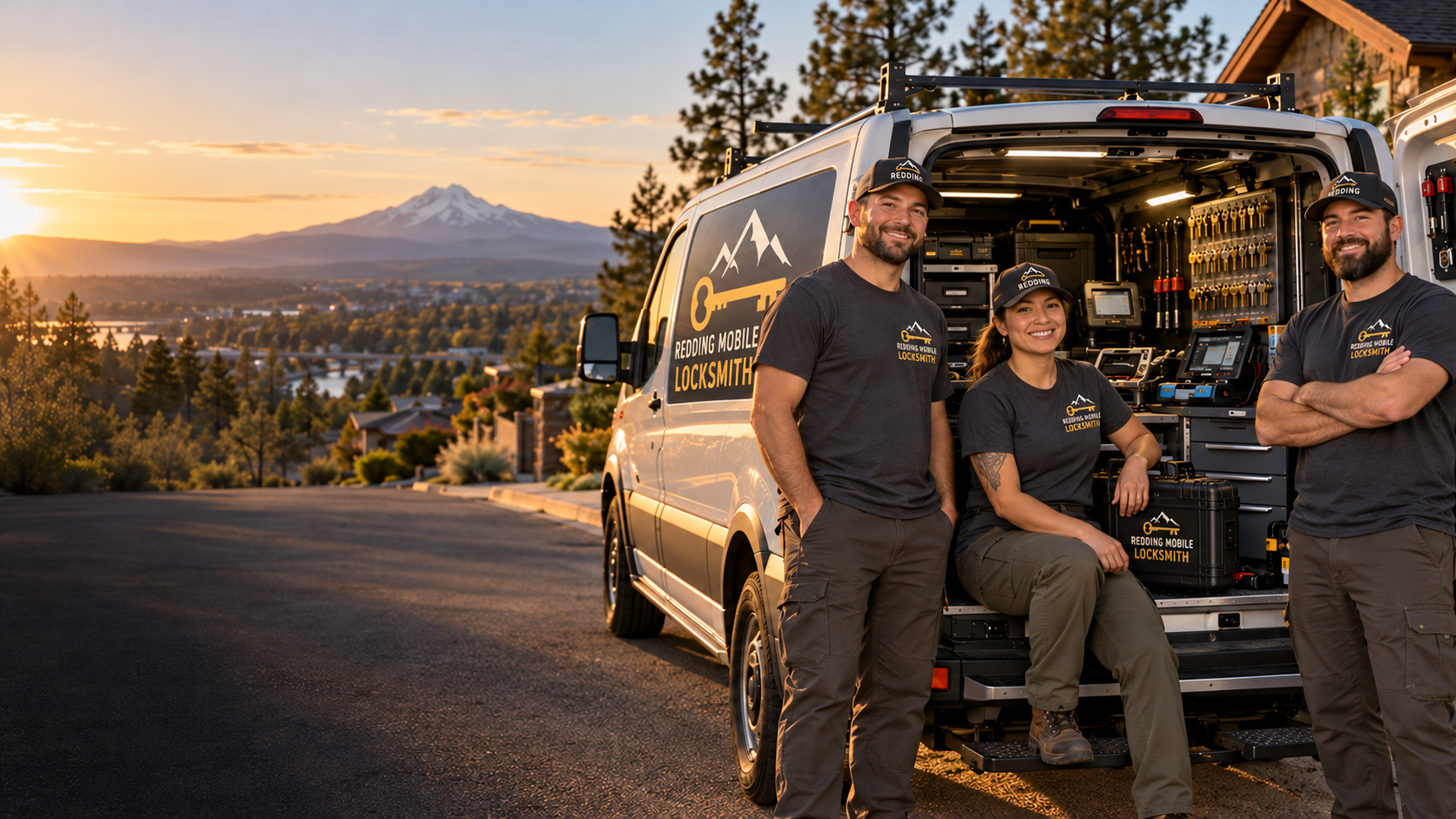
A business with a broken lock cannot always close for the afternoon. That is why we work from a branded service van with uniformed technicians. The van carries professional tools, key cutting and programming equipment and common hardware, so many jobs can be finished at the door without a second trip.
We are available around the clock, which matters for a shop that finds its door forced open on a Sunday morning or a gate that will not latch late at night. We do not publish response times because we do not want to promise something that traffic, weather or other calls could change. We will tell you what to expect when we speak with you.
Our crew covers the nearby towns too, including Redding and Anderson, which matters for contractors and delivery businesses whose routes cross town lines. Our full Shasta Lake service page shows the local picture.
Lake visitors, commuters and the buildings that serve them
Because Shasta Lake draws visitors from out of the area and sends many residents up Interstate 5 each day, the businesses here keep odd hours. A shop may open early for people heading to the water and close late for people coming home. Someone locks that door at the end of a long shift, often in the dark and often tired, which is exactly when a sticking deadbolt or a bent latch becomes a real problem.
That pattern shapes what we look for. We check that the lock throws all the way without leaning on the door, that the door sits square so the bolt meets the strike cleanly, and that the key turns smoothly without a hard twist. A lock that works only if you lift the handle or push with your shoulder is a lock that will eventually leave you standing outside.
Seasonal change matters as well. Hot, dry valley summers expand wood and metal and can make doors drag, while cool, damp stretches can swell a wooden frame. Small shifts like these move a strike out of line by a fraction, and a fraction is enough. A short adjustment now saves a late night call later, and we can often make it on the same visit as another job.
How to prepare before we arrive
A few minutes of preparation makes a commercial call smoother. Gather the keys you still have, even the ones that do not work. Know which door or opening you need attention on first. If you are a tenant, have the owner or manager reachable in case permission is needed. If the lock was forced, avoid touching the damaged area more than necessary.
Photos help us plan. A picture of the door, the lock and the frame tells us a lot before we get there. It does not replace an in person look, but it helps us bring the right parts.
If you want to start the conversation now, the request form on our contact page is the place to describe what you have. Tell us what kind of business it is, which door is affected and whether it is safe to leave the building as is.
- Gather every key you still have, working or not.
- Note whether the lock is damaged, stuck or simply missing a key.
- Have the owner or manager reachable if you rent.
- Take a clear photo of the door, lock and frame.
Common questions
What kinds of business doors can you work on in Shasta Lake?
We work on front doors, back doors, storage rooms, gates, office suites and small property buildings. We also help with vehicle and toolbox locks that belong to a business. If you are unsure whether your door counts, describe it in the request form and we will tell you what we can do.
Can you change locks so a former employee's key stops working?
Yes. Rekeying changes the inside of the cylinder so old keys no longer fit, and new keys are cut for the people who should have access. It is usually the simplest answer when you cannot account for every copy. We also give you a clear list of who holds what.
Do I need to replace the whole lock if a key is lost?
Often you do not. If the lock itself is sound, rekeying gives you new keys at the same door and makes the lost one useless. Replacement makes more sense when the lock is worn, damaged, forced or the wrong grade for how the door is used.
Can you help if I rent my space?
Yes, but permission matters. Leases and building owners set their own rules about who can change a lock and who pays, and we cannot give legal advice. Check with the owner or manager first. We can explain what is physically possible while you confirm.
Do you handle exit doors and panic bars?
We can repair and adjust exit devices so they work the way they were built to. Whether your building needs a particular device depends on its use and local requirements, which vary. Ask your landlord or the local authority for that answer.
How do I start a request for my business?
Use the request form on the contact page and describe the building, the door and what happened. Our phone line is coming soon, so the form is the way to reach us for now. The more detail you give about the lock, the better prepared we arrive.