
Home / Field notes / RV and camper locks
Field notes: RV
RV and camper locks, from the entry door to the storage bays
A camper has more locks than most people count: an entry door, a row of outside storage bays, sometimes a hitch or a cab door. Here is how each one works and what to do when one fails.
Why a camper is not one lock, it is five or six
Walk around a travel trailer or a motorhome and count the keyholes. There is the main entry door, usually with a keyed latch and a deadbolt. There are outside storage bays, each with its own small latch. There may be a cab door on a motorhome, an ignition, a fuel door, a hitch or coupler lock, and sometimes a spare tire cover. Every one of those is a separate lock with its own job and its own failure modes.
Across the North State, campers sit in driveways, in storage yards, at lakeside sites around Shasta Lake and Lakehead, and at trailheads along Interstate 5 and Highway 299. Owners tend to treat them as one thing, one key ring, one problem. That habit is where most trouble starts, because a lockout at the entry door is a very different job from a seized bay latch or a lost ignition key.
On this page we take them one at a time, in the order a crew would think about them. If you want the wider picture of vehicle keys first, our guide to car key types in plain words covers the cab side, and the automotive locksmith page explains the work we do on vehicles.
The entry door latch and deadbolt
Most camper entry doors use a latch mechanism that is built into the door skin, with a keyed cylinder on the outside and a handle or paddle on the inside. Many also carry a small deadbolt that throws a bolt into the frame. The door itself is thinner than a house door and the frame is lighter, so the hardware is designed to hold the door shut against road vibration and casual tampering, not to stop a determined person.
The cylinder is a small tubular or flat key design. It can be worn, corroded by road spray and dust, or gummed up by sunscreen, bug repellent and general grime. A key that has gone stiff is a warning. Forcing it risks snapping the key in the cylinder, and a broken key in a camper door is more awkward than in a house because there is less room around the cylinder to work.
Because the door skin is thin, the latch body is held on with only a few small screws. A latch that rattles, a handle that spins without pulling the bolt, or a door that no longer lines up with its strike are all signs of hardware that needs attention before it fails with the family standing outside.
Storage bay locks and why keys are often shared
The outside compartments on a camper are usually closed with small cam style locks or paddle latches. A cam lock is a short cylinder with a flat arm on the back. Turn the key and the arm swings out of the way, freeing the door. These locks are simple, light and inexpensive to build, which is why a whole row of bays may use the same key or a very small set of key patterns.
That convenience has a side effect. If many campers come from the same builder, a key that fits one unit can sometimes fit another. It is not a reason to panic, because bay locks protect gear rather than your home, but it does mean you should not store anything valuable behind a basic bay latch and call it secure. Valuables belong inside, out of sight.
If you have lost the bay key, a locksmith can often cut a new one from the lock itself or replace the cylinder with one that takes a different key. Replacing with a different pattern is worth considering if you bought the camper used and have no idea how many previous keys are floating around. For a wider look at what changing a key pattern involves, see our page on rekeying.
- Count every keyed lock on the unit and note which key opens which one.
- Check whether the bays share a key, and decide whether that is acceptable for what you store.
- Keep tools, fuel containers and anything with real value out of the outside bays.
- Replace a bay lock that feels loose, rough or sticky before it jams.
The hitch, coupler and cab door
A trailer coupler lock is a small pin or sleeve that prevents the trailer from being hooked up to another vehicle while it is parked. It is a deterrent, not a vault. Its job is to make a quiet theft slower and louder, and it works well alongside a wheel lock or a well lit parking spot. Keys for these locks are often kept in a glove box or toolbox, and they are the ones people lose most often.
On a motorhome, the cab doors and the ignition follow the same rules as any other vehicle. The key may be a plain metal blade, a transponder key with a chip inside the head, or a remote with a flip out blade. Which one you have decides whether a replacement can be cut on the spot or needs to be programmed to the vehicle. Our guide to transponder keys explains the difference in plain words.
If your unit is a towed trailer, there is no ignition at all, so the keys that matter are the entry door, the bays, the coupler and any wheel lock. That is a short list, and it is worth writing down where each one lives before the season starts.
What weather does to camper locks in this region
The valley floor around Redding and Anderson gets long, hot, dry summers. A camper parked in direct sun can turn into an oven, and metal latches and plastic housings expand and contract through the day. Over a few seasons that movement can loosen screws, warp plastic bay doors and leave a lock that works in the morning and sticks in the afternoon.
Up in the mountain towns, the problem flips. Around Mount Shasta, McCloud, Dunsmuir and Weed, winter brings snow, hard frost and wet cold. Moisture gets into a lock cylinder, freezes overnight, and turns a smooth key into a stubborn one. A camper that sits unused all winter in a snowy lot is a prime candidate for a frozen or corroded latch in spring.
Both ends of the climate argue for the same habit. Work the key in every lock a few times when you take the camper out of storage, and use a graphite based or dry lock lubricant, not a heavy oil. Our notes on which lubricants help and which hurt go into the reasons.
Locked out of your own camper
A lockout at a camper is not the same as a lockout at a car. The door may have a deadbolt as well as a latch, the windows are usually small and sealed, and the owner often has a good deal of gear inside. Some people try to force a window or pry the door skin, and that is almost always the most expensive way to get in.
A professional approach starts with finding out which lock is holding the door shut and why. If the key simply will not turn, the fix may be cleaning or replacing a worn cylinder. If the key is inside, the job is to open the latch without harming the door skin or the frame. We do not describe the technique, but the goal is always to leave the door able to lock again afterwards.
If you are at a campground and cannot reach the key, take a breath and think about whether anyone in your party has a second one. Then reach out through our request form and tell us the make of unit, the type of lock, and where you are in the region. For the wider picture of how we handle vehicle and building lockouts, see car lockout and 24 hour emergency locksmith.
Lost keys and replacement options
If you bought a camper secondhand, assume that some keys are missing. Previous owners rarely hand over every copy, and a shop or dealer may have cut spares that you do not know exist. A new owner should treat the first week as an opportunity to reset the locks, not just accept whatever keys came in the glove box.
For a basic entry door, the cylinder can often be rekeyed to a new pattern, or replaced with one that uses a key you control. For bay locks, replacement cylinders are inexpensive and easy to swap, and a locksmith can do the whole row in one visit. For a motorhome ignition, the job depends on the vehicle, and a new key may need programming. That is the territory of key programming and car key replacement.
Give yourself a clear path before you travel. Make one spare of the entry key and one of the ignition key, and keep the spare somewhere that is not inside the camper. It is a small step, and it turns a trip ending problem into a minor nuisance.
A short routine before you tow or park for the season
Most camper lock trouble can be spotted before it happens. At the start of the season, do a walk around with the keys in your hand and try each lock. Does the key go in smoothly, turn without grinding, and release the latch cleanly? Does the door close and seat against its seal? Does the strike plate on the frame line up with the latch? Anything that feels off is easier to fix now than on the road.
Do the same at the end of the season, and add a short check of any gaps where water can get into a cylinder. A dust cap or a thin cover on an outside lock keeps road spray out. If your camper lives in a storage yard, think about where the spare keys are, who else has access, and whether a stranger could have copied a bay key.
The routine takes ten minutes and a handful of checks. It is the sort of habit that people keep for years once they have been caught out once. If something turns up, our lock repair and lock installation pages explain what we can do.
- Try every key in every lock and note any that feel rough.
- Check that the entry door latch seats fully and the strike lines up.
- Wipe road grime from outside cylinders and add a dry lubricant if needed.
- Confirm you hold at least one spare of each key somewhere outside the unit.
- Photograph the key tags so you know which key belongs to which lock.
Security habits that cost nothing
A camper that looks occupied and cared for is less attractive than one that looks abandoned. Keep curtains closed on windows that face the road, take valuables inside the house when the unit is parked at home, and avoid leaving a spare key tucked in an obvious spot such as a wheel well or behind a license plate. Those are the first places anyone checks.
If your camper spends the off season in a storage yard, ask the yard how access is controlled and who else holds a gate code. You are not asking for anything unusual. A yard that takes care of its entry point is worth more than any single lock you add to your own unit. Rules and policies differ from yard to yard, so ask what applies at yours.
Finally, think about what you actually keep inside. Many owners leave documents, medication, tools and electronics in a camper for months. A short list of what is inside, kept at home, helps you notice if anything goes missing and gives you something concrete to describe if you ever need to talk to anyone about it.
When to call us and what to tell us
Call when a key snaps, when a latch will not release, when keys are lost, or when you have bought a unit and want every lock under your control. For anything involving an ignition on a motorhome, call before you try to force anything, because damage to an ignition cylinder turns a simple key job into a repair.
When you reach out, tell us what kind of unit it is, whether it is a towed trailer or a motorhome, which lock is the problem, and what you have already tried. Describe where you are in general terms, such as the town or the highway. We do not publish a phone line yet, so use the request form and we will pick it up from there.
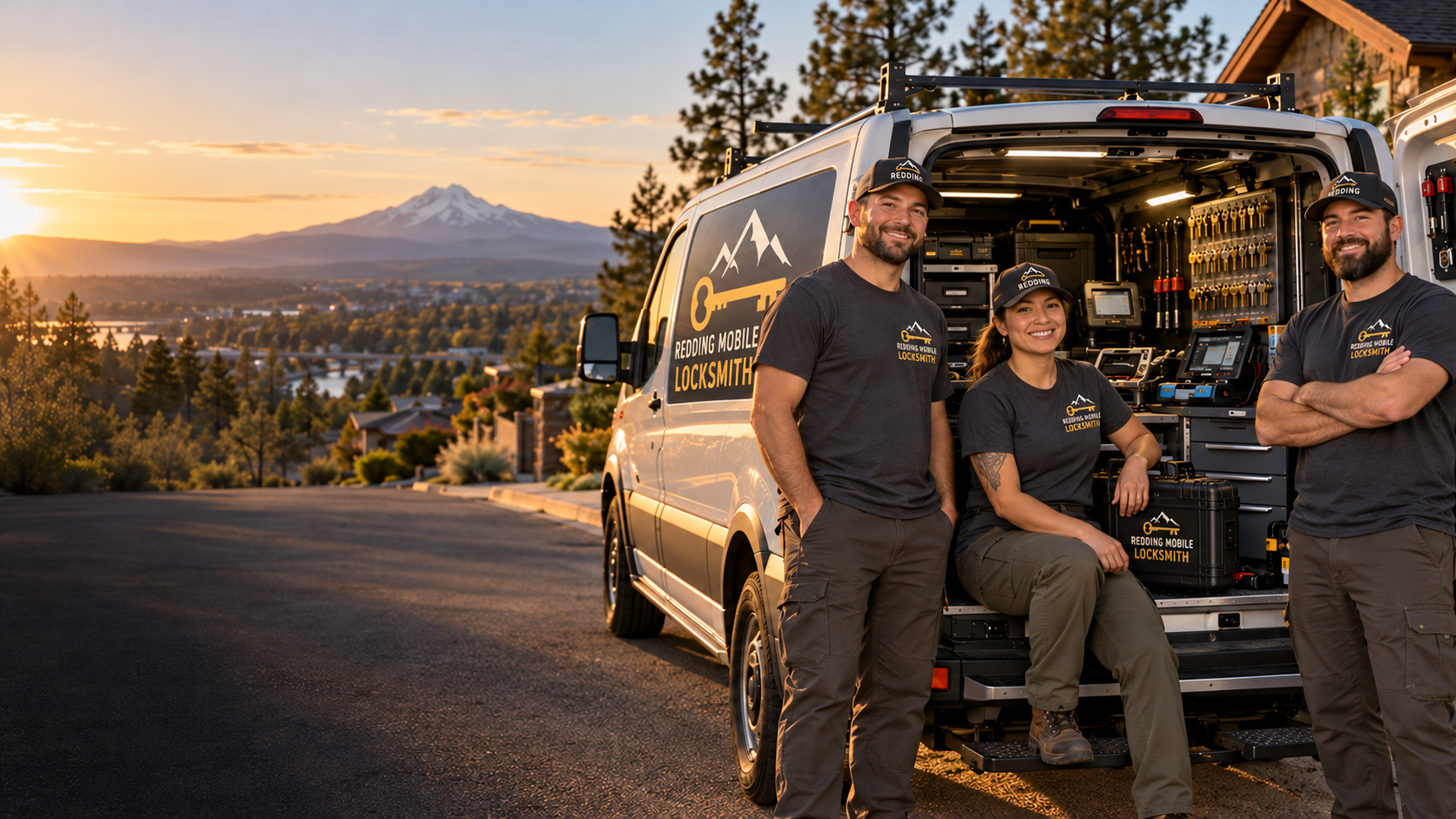
Our team arrives in a branded service van with the tools, key cutting equipment and common hardware for this kind of work. If a part is not on the van, we will tell you plainly what is needed. That is how a working crew should talk to someone standing by a camper at the end of a long day.
Common questions
Do all RV storage bays use the same key?
Many do not share one key across a whole fleet, but a lot of campers use a small set of key patterns on their bay locks. That means a key from another unit can sometimes fit yours. If you bought a unit used, replacing or rekeying the bay locks is a sensible way to know exactly who holds a working key.
Can a camper door lock be rekeyed?
In most cases yes. The cylinder can be reset to accept a new key, or swapped for a new cylinder. Whether it is worth rekeying or replacing depends on how worn the cylinder is. A rough, corroded cylinder is better replaced; a clean one can often be rekeyed during a single visit.
What should I do if my camper key breaks in the lock?
Stop turning it. Do not try to dig out the piece with a pin or a knife, because that can push it deeper or damage the cylinder. Keep any broken pieces, note which lock it is, and contact a locksmith. Extracting a broken key is routine work when the cylinder has not been forced.
Why does my camper lock stick in cold weather?
Moisture inside the cylinder can freeze overnight, and cold also thickens old lubricant. In mountain towns this is common after snow. Do not force the key. Gentle warmth on the key and a dry lubricant after the lock frees up usually helps, and a cylinder that keeps sticking should be cleaned or replaced.
Do I need a programmed key for a motorhome?
Often yes. Many motorhome cabs use a key with a chip inside, and a replacement has to be programmed to the vehicle before it will start the engine. A plain metal key may open the door but not run the motor. Check your key head for a thick plastic section, which usually points to a chip.
Can you make a new key if I have lost every copy?
Often we can, because many camper locks can be read and a key cut from the cylinder itself. The details depend on the lock type. For a vehicle ignition with a chip, programming equipment is involved. Use the request form and describe the unit, and we will tell you what the job would involve.